

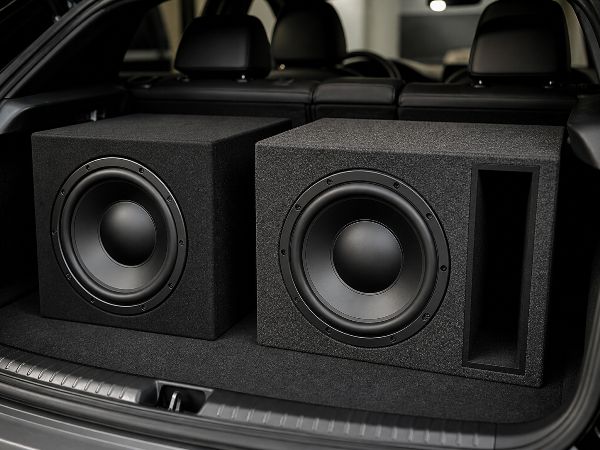
You’ve invested in a high-quality subwoofer, picked out a powerful amplifier, and you’re ready to feel the music. But then you hit a wall: the box. It seems like a simple wooden enclosure, but the “house” you build for your subwoofer is responsible for nearly 50% of the final sound quality.
Are you looking for that tight, punchy kick that vibrates your chest, or do you want the deep, rattling low-end that people hear three blocks away? This choice usually boils down to one classic debate: Sealed vs. Ported.
Choosing the wrong enclosure can make a $500 subwoofer sound like a $50 bargain bin find. In this comprehensive guide, we will break down the science of air pressure, acoustics, and cabin gain to help you decide which enclosure will transform your car’s audio system into a masterpiece.
Key Takeaways at a Glance
| Feature | Sealed Enclosure | Ported (Vented) Enclosure |
| Primary Goal | Accuracy and Musicality | Volume and Deep Bass |
| Bass Quality | Tight, precise, and “quick” | Boomy, powerful, and resonant |
| Size | Compact and space-saving | Larger and requires more trunk space |
| Efficiency | Low (needs more power) | High (louder with less power) |
| Best For | Jazz, Rock, Classical, Metal | Hip-Hop, EDM, Dubstep, Movies |
Understanding the Basics: Why Does the Enclosure Matter?
To understand how to choose the right subwoofer enclosure, we first need to look at how a speaker works. A subwoofer produces sound by moving back and forth. When the cone moves forward, it creates a sound wave. However, it also creates a sound wave when it moves backward.
Without a box, these two waves cancel each other out, resulting in almost zero bass. The enclosure’s job is to manage that rear wave.
The Role of Air Pressure
Think of a subwoofer enclosure like a spring. In a sealed box, the air inside acts as a shock absorber. It pushes back against the cone, helping it return to its original position quickly. In a ported box, the air moves through a vent, using the resonance of the air itself to reinforce the sound coming off the front of the speaker.
Sealed Enclosures: The Purist’s Choice
A sealed enclosure is exactly what it sounds like: a completely airtight box. This is the most common type of enclosure for those who prioritize sound quality (SQ) over sheer volume.
Why You Might Love a Sealed Box
The “tight” bass associated with sealed boxes happens because the internal air pressure acts as a control mechanism. This prevents the subwoofer from “over-excursion,” ensuring that every note stops and starts exactly when the recording dictates. If you listen to fast-paced music like heavy metal or complex jazz, a sealed box will keep up with every drum beat without blurring the notes together.
The Trade-offs
The main downside is efficiency. Because the air inside the box is constantly fighting the movement of the cone, the subwoofer requires more power from your amplifier to reach high volume levels. Additionally, sealed boxes don’t produce as much “low-end extension” compared to ported designs.
Ported Enclosures: Maximum Output and Deep Lows
A ported (or vented) enclosure features a built-in tunnel or “port” that allows air to flow in and out of the box. This port is “tuned” to a specific frequency.
The Physics of the Port
When the subwoofer moves, it pushes air through the port. At the “tuning frequency,” the air moving out of the port is actually in phase with the air moving off the front of the cone. This creates a massive boost in volume—often 3dB to 6dB louder than a sealed box using the same power.
Why Choose Ported?
If you want your bass to be felt as much as it is heard, ported is the way to go. It excels at reproducing the heavy, sustained notes found in modern rap and electronic music. It is also a great choice if you have a lower-powered amplifier.
The Challenges
Ported boxes are significantly larger than sealed ones. If you drive a compact car, a properly spec’d ported box might take up your entire trunk. Furthermore, if a ported box is not designed correctly for the specific subwoofer, it can sound “peakish” or muddy.
Sealed vs. Ported: A Side-by-Side Comparison
When deciding how to choose the right subwoofer enclosure, consider these three critical factors:
1. Accuracy vs. SPL (Sound Pressure Level)
- Sealed: Focuses on the “flat” response. It reproduces the music exactly as the artist intended.
- Ported: Focuses on “SPL.” It is designed to be loud and impactful.
2. Available Space
- Sealed: Ideal for small trunks or under-seat installations.
- Ported: Requires careful calculation of internal volume and port displacement.
3. Power Handling
If you have a massive 1500-watt RMS amplifier, a sealed box can handle that power safely because the air pressure protects the woofer. In a ported box, you must be careful with low frequencies below the tuning point.
How Cabin Gain Affects Your Choice
One “secret” in the car audio world is cabin gain. A car’s interior is a small, enclosed space that naturally boosts low frequencies.
- Sealed boxes naturally roll off at low frequencies, but cabin gain often fills that gap perfectly.
- Ported boxes already have strong low-end energy, which can become overwhelming without proper tuning.
Professional Installation: Why Custom is Better Than Prefab
You might be tempted to buy a prefab box. While convenient, these are built to a one-size-fits-all standard.
Every subwoofer has unique Thiele/Small parameters that dictate how much air it needs. A custom-built enclosure ensures optimal performance.
If you are in Southern California, seeking a professional car audio consultation is the best way to maximize performance.
Frequently Asked Questions (FAQ)
Which enclosure is better for all-around music?
A sealed enclosure is usually the safer, more balanced choice.
Can I put any subwoofer in a ported box?
Not necessarily. Always check the manufacturer’s specifications.
Does the material of the box matter?
Yes. MDF or Baltic Birch plywood are commonly used for rigidity.
Is a ported box bad for sound quality?
No. A well-designed ported box can sound excellent.
Conclusion
Choosing the right subwoofer enclosure is key to achieving the best audio experience. If you value precision and compact size, go with Sealed. If you want maximum output and deep bass, choose Ported.
Regardless of your choice, the enclosure is just as important as the speaker itself.
Ready to transform your drive?
If you want the perfect bass setup tailored to your vehicle and taste, visit Sorena Car Audio in Irvine, CA.
We offer all car audio services
List of Services:
- DashCam
- Ambient Lighting
- Starlight
- Windows Tinting
- Armoring & Ballistic Protection
- Apple CarPlay
- Dash Upgrade
- Android Auto
- Paint Protection Film (PPF)
- Sound Deadening – Sound Proofing
- Front and Rear Parking Sensors
- Blind Spot Radars
- Car Ceramic Coating
- HD Backup Camera
- Mirror Monitor
- Subwoofer Integration
- Classic Car Audio
- Wheel Well Sound Deadening
- Marine Audio System
- Marin Audio
- Flipdown Monitor
- Bluetooth Integration
- Rear Entertainment System
- Steerig Wheel Upgrade
- Car Wrapping
- Interior Suede Alcantara Wrap
- Alcantara Suede Headliner
- ECU Tuning
- Center Console Safe Installation
Leave A Comment