

Building a high-performance audio system inside a vehicle presents one of the toughest challenges in acoustic engineering. Unlike home listening rooms or dedicated recording studios, an automobile cabin is a chaotic acoustic environment dominated by competing noise sources and harsh reflective surfaces.
Achieving true high-fidelity automotive sound quality requires solving two distinct physical problems: blocking low-frequency road noise from invading the cabin and controlling early reflections and standing waves inside a tiny enclosure. Without addressing these physical barriers, upgrading speakers or amplifiers often just makes a noisy, reflections-heavy system sound louder rather than clearer.
| Core Acoustic Challenge | Physical Cause | Strategic Solution |
| Structure-Borne Noise | Metal body panels vibrating from tire-road contact | Constrained Layer Damping (CLD) mats to dissipate mechanical energy |
| Airborne Road & Engine Noise | Ambient environmental noise penetrating cabin gaps and thin metal | Decoupled Mass Loaded Vinyl (MLV) barrier layers |
| Comb Filtering & Smearing | High frequencies bouncing off windshields and side glass | Directivity control, acoustic absorption, and targeted DSP time alignment |
| Low-Frequency Peaks/Dips | Cabin modes and standing waves in small enclosure volume | Parametric equalization and strategic speaker placement |
Why Vehicle Cabins Destroy Audio Fidelity
A vehicle interior is acoustically hostile by design. To understand why stock or even upgraded car stereos often sound muddy or harsh, you must look at how sound waves interact with the physical geometry of an automobile.
1. The Dual Threat: NVH vs. Acoustic Reflections
Noise, Vibration, and Harshness (NVH) enters the cabin through two distinct pathways:
- Structure-Borne Vibration: Energy from the tires, suspension, and engine transfers through the steel chassis, turning door skins, floor pans, and roof panels into giant acoustic diaphragms.
- Airborne Noise: Tire squeal, wind turbulence, and ambient exhaust noise penetrate thin body panels, door seals, and firewall gaps.
Simultaneously, the sound coming out of your speakers hits glass, hard vinyl, and painted plastic. These hard, non-porous surfaces reflect mid and high frequencies almost entirely, creating immediate echo paths that arrive at your ears a few milliseconds after the direct speaker signal.
2. Comb Filtering and Phase Cancellation
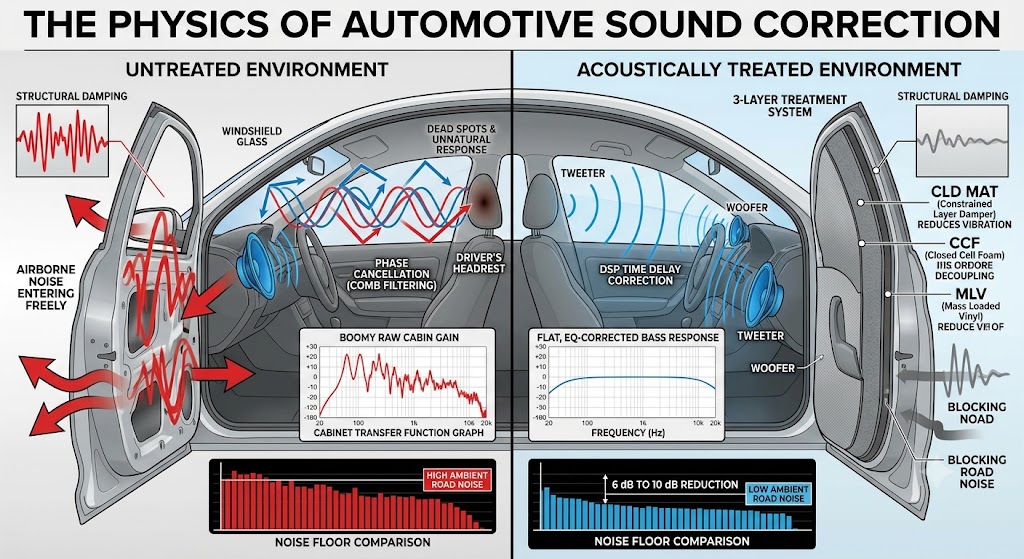
When direct sound from a door speaker mixes with reflected sound bouncing off the side window or dash, the acoustic waves interact. If the direct wave and reflected wave arrive out of phase, they cancel each other out at specific frequencies while doubling output at others. This creates a jagged frequency response curve known as comb filtering. In practice, this causes vocal clarity to disappear and instruments to sound harsh or distant.
3. Asymmetric Path Length Differences
In a standard 2-channel home audio setup, the listener sits centered between two speakers at equal distances. In a car, the driver sits inches away from the left speaker and feet away from the right speaker. This physical imbalance causes sound from the left speaker to arrive first, pulling the soundstage sharply to the left side of the dashboard.
Overcoming Road Noise: The Three-Layer Acoustic Treatment Method
To maximize dynamic range, you must lower the cabin noise floor. Throwing a single layer of peel-and-stick matting onto every surface will not block airborne road noise. Effective sound deadening requires a scientifically engineered three-layer approach.
Acoustic Barrier System Layout

Trim Panel / Interior Carpet
Layer 3: Closed-Cell Foam (Decoupler / Absorber)
Layer 2: Mass Loaded Vinyl (Airborne Barrier)
Layer 1: CLD Mat (Vibration Damping on Steel)
Vehicle Sheet Metal Body Panel
Layer 1: Vibration Control with Constrained Layer Damping (CLD)
CLD materials consist of a dense butyl rubber compound bonded to a thick aluminum constraint layer.
- How it works: When sheet metal flexes, the viscoelastic butyl shears against the aluminum foil. This friction converts mechanical kinetic energy directly into low-grade heat, stopping panel resonance.
- Application Rule: You do not need 100% coverage to stop panel vibration. Covering 50% to 70% of the flat center of a metal panel provides maximum damping performance; additional coverage yields diminishing returns while adding unnecessary weight.
Layer 2: Decoupling with Closed-Cell Foam (CCF)
Closed-cell foam acts as a thermal barrier, cushion, and physical decoupler.
- How it works: Placing CCF directly over the CLD layer prevents panel-on-panel buzzing between plastic interior trim and metal bodywork. More importantly, it creates an essential air gap for the acoustic barrier layer above it.
Layer 3: Blocking Airborne Sound with Mass Loaded Vinyl (MLV)
Mass Loaded Vinyl is a dense, heavy material weighing roughly 1 lb per square foot.
- How it works: Unlike absorbers, MLV acts as an impenetrable barrier that reflects airborne noise back toward the road.
- Application Rule: MLV must be installed as an uninterrupted layer with 100% sealed seams using vinyl seam tape or contact adhesive. Even small gaps or unsealed pass-throughs degrade acoustic barrier performance significantly.
Taming Cabin Reflections and Standing Waves
Once external noise is suppressed, the focus shifts to controlling the internal acoustic environment. Small, irregularly shaped cabin spaces suffer from acoustic phenomena called cabin modes and standing waves.
Acoustic Absorption on Hard Surfaces
Hard plastic dash panels and automotive glass cannot easily be removed, but secondary reflection points can be softened:
- Door Cards & Pillar Trim: Applying acoustic absorption materials (such as hydrophobic micro-fibrous fleece or open-cell acoustic foam) inside door cavities and behind A-pillar trim absorbs mid-to-high frequency energy before it reflects into the cabin.
- Floor Matting & Headliners: Soft carpeting and upholstered headliners serve as crucial acoustic absorbers for high-frequency flutter echoes.
Controlling Low-Frequency Transfer Function
Vehicle cabins act like small pressure chambers at low frequencies. Frequencies with wavelengths longer than the length of the interior (typically below 60 Hz to 80 Hz) undergo a natural boost known as cabin gain or transfer function.
While cabin gain boosts deep bass output, it can create bloated, boomy low frequencies if unmanaged. Properly calculating enclosure volumes and using precise equalization filters helps maintain tight, controlled bass response.
Digital Signal Processing (DSP): The Final Frontier of Car Audio Tuning
Physical acoustic treatment solves 60% of the cabin equation. The remaining 40% requires precise digital correction using a dedicated Digital Signal Processor (DSP).
[ Speaker ] <--- Signal Delay (0.00 to 10.00 ms) <--- [ DSP Engine ] <--- Line-Level Audio Input
                                                              ^
                                                    [ Real-Time Analyzer (RTA) ]
1. Signal Time Alignment
Because speakers sit at unequal distances from the driver, DSP processors introduce tiny time delays (measured in milliseconds or inches) to the nearest speakers. By delaying the audio signal to the left-front tweeter and midbass driver, sound waves from all speakers hit the listener’s ears at the exact same instant, forming a focused stereo image centered on the dashboard.
2. Independent Channel Parametric Equalization
Comb filtering and surface reflections cause severe peaks and dips in frequency response. Using a calibrated measurement microphone and a Real-Time Analyzer (RTA), an audio technician can apply individual parametric EQ to every speaker channel. This flattens acoustic anomalies without overdriving speakers or forcing clean amplifiers into clipping.
3. Active Crossover Slopes
Passive crossovers included with speaker sets cannot compensate for individual speaker positions inside a car door. Active DSP crossovers allow precise frequency band assignment (e.g., 24 dB/octave Linkwitz-Riley filters), preventing low frequencies from distorting delicate tweeters and eliminating phase cancellation between midbass drivers and subwoofers.
For step-by-step guidance on setting up active filters, read our guide on configuring multi-channel DSP crossovers.
Strategic System Upgrade Checklist
To get the highest return on investment, follow this structured upgrade path:
- Acoustic Door Preparation: Apply CLD mats to outer door skins and seal inner door access holes to convert doors into sealed enclosures.
- Floor Pan & Wheel Arch Treatment: Install CLD + CCF + MLV layers over the floor pan and rear wheel arches to block tire and road roar.
- Speaker Pointing & Aiming: Mount tweeters on axis or semi-on-axis toward the center console to increase direct-to-reflected sound ratios.
- Integration of a DSP Amplifier: Route factory or aftermarket signals through a DSP to correct time alignment and equalization errors.
- Acoustic Measurement & RTA Tuning: Measure cabin frequency response with an RTA microphone to eliminate room modes and peaks.
For an in-depth breakdown on choosing materials for your vehicle model, check out our vehicle acoustic deadening guide.
Frequently Asked Questions
Does sound deadening really make a noticeable difference in car audio?
Yes, high-quality sound deadening provides a dramatic, measurable improvement. By reducing structural vibrations and blocking external road noise, it significantly lowers the cabin noise floor. This allows subtle audio details to become audible without cranking the volume to harmful levels, while improving midbass response by turning flexing metal door panels into rigid enclosures.
Can I fix poor car acoustics just by buying more expensive speakers?
No, upgrading speakers without addressing cabin acoustics often leads to disappointing results. High-end speakers reproduce sound with greater accuracy, which means they also reveal harsh cabin reflections, comb filtering, and low-frequency resonance even more clearly. Without acoustic damping and DSP tuning, even top-tier aftermarket speakers will suffer from vehicle-induced distortion.
What is the difference between sound deadening and sound blocking?
Sound deadening materials (like butyl-based CLD mats) add mass and damping to thin metal panels to stop vibrations. Sound blocking materials (like Mass Loaded Vinyl) are heavy, dense barriers designed to block airborne noise from passing through body panels into the interior. Damping stops metal ringing, while blocking keeps outside traffic and road noise out.
Why does bass sound boomy or muddy in my car?
Boomy bass is caused by a combination of unsealed door cavities, panel resonance, and natural cabin gain. Small cabin spaces amplify sub-bass frequencies naturally. When loose metal panels vibrate in sympathy with low notes, bass frequencies smear together. Properly dampening the trunk and doors while using parametric EQ to pull down cabin resonance peaks resolves this issue.
How does a DSP improve the soundstage on a dashboard?
A Digital Signal Processor (DSP) uses millisecond-level time alignment to correct for uneven speaker distances. By slightly delaying sound from the speakers closest to the driver, waves from all channels arrive at your ears at the same exact microsecond. This creates the illusion of a realistic, wide soundstage floating directly above the dashboard.
Conclusion
Achieving audiophile-grade automotive sound quality is an engineering discipline centered on physics and measurement. By suppressing structure-borne vibrations with CLD mats, blocking airborne road noise with decoupled MLV barriers, and eliminating cabin reflections through DSP time alignment and parametric equalization, you transform a noisy automotive interior into a pristine acoustic environment.
If you are ready to eliminate road noise and unlock the full potential of your vehicle’s audio system, trust the professionals. Sorena Car Audio offers custom acoustic treatments, precision sound deadening installations, and advanced DSP tuning tailored specifically to your vehicle’s unique acoustic signature.
Reviewed by the technical audio integration team at Sorena Car Audio. This content reflects professional acoustic installation standards, modern DSP calibration techniques, and current automotive sound deadening practices.
We offer all car audio services
List of Services:
- DashCam
- Ambient Lighting
- Starlight
- Windows Tinting
- Armoring & Ballistic Protection
- Apple CarPlay
- Dash Upgrade
- Android Auto
- Paint Protection Film (PPF)
- Sound Deadening – Sound Proofing
- Front and Rear Parking Sensors
- Blind Spot Radars
- Car Ceramic Coating
- HD Backup Camera
- Mirror Monitor
- Subwoofer Integration
- Classic Car Audio
- Wheel Well Sound Deadening
- Marine Audio System
- Marin Audio
- Flipdown Monitor
- Bluetooth Integration
- Rear Entertainment System
- Steering Wheel Upgrade
- Car Wrapping
- Interior Suede Alcantara Wrap
- Alcantara Suede Headliner
- ECU Tuning
- Center Console Safe Installation
Leave A Comment