

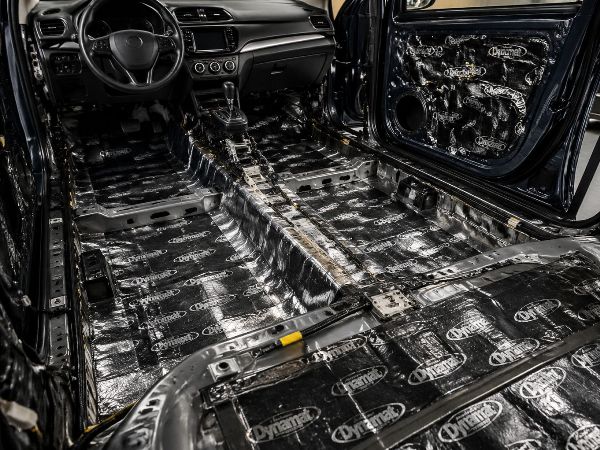
You’re driving down the freeway, and even though the windows are rolled up tightly, it feels like you’re sitting inside a giant tin drum. The road hum is deafening, the door panels are rattling to the beat of your music, and a mysterious “shaking” sensation through the floorboard is making your commute feel more like an endurance test than a joyride.
If this sounds familiar, your vehicle is likely suffering from poor NVH (Noise, Vibration, and Harshness) control. Most factory cars are built with thin sheet metal that acts as a diaphragm, amplifying engine noise and road vibrations. The solution isn’t just turning up the volume—it’s car sound deadening.
In this ultimate guide, we will explore the science of acoustic insulation, the difference between various damping materials, and why a professional approach to vibration control is the only way to achieve a true “luxury car” silence.
Key Takeaways at a Glance
| Strategy | Primary Material | Function | Best For |
| Vibration Damping | Butyl Rubber (CLD) | Converts kinetic energy into heat | Rattling panels, thin metal flex |
| Sound Blocking | Mass Loaded Vinyl (MLV) | Reflects airborne noise | Road noise, tire roar, exhaust drone |
| Sound Absorption | Open-Cell Foam / Fibers | Absorbs mid-to-high frequencies | Interior echoes, wind noise |
| Decoupling | Closed-Cell Foam (CCF) | Creates a physical gap | Preventing panels from rubbing |
The Science of Silence: Why Your Car Vibrates
To fix a shaking car, you must first understand the physics of the problem. Automotive noise is categorized into two paths: structure-borne and airborne.
- Structure-Borne Noise
This occurs when the physical components of your car—the engine, transmission, and suspension—vibrate against the chassis. These vibrations travel through the metal panels of your car. Because metal is highly elastic, it doesn’t dissipate energy well; instead, it rings like a bell. Research into damping alloys suggests that the most effective way to suppress this is to use materials with high energy dissipation properties at the source or along the transmission path (Burshukova et al., 2023).
- Airborne Noise
This is the sound of wind whistling past your mirrors or the roar of tires on asphalt. Unlike structure-borne noise, this enters the cabin through gaps in seals or by vibrating the air inside the cabin. High-speed electric vehicles, for instance, face unique challenges where tire cavity noise becomes more prominent due to the lack of engine mask (Shi et al., 2025).
Understanding Constrained Layer Damping (CLD)
The “gold standard” for professional car sound deadening is a technique known as Constrained Layer Damping (CLD).
CLD involves a “sandwich” of materials: a base layer of sheet metal, a viscoelastic core (usually butyl rubber), and a constraining layer (usually aluminum foil). When the car’s metal panel tries to bend or vibrate, the viscoelastic layer is forced into a “shear” motion. This shear motion converts the mechanical energy of the vibration into a tiny amount of heat, effectively “killing” the vibration (Shafer, 2013).
Why Butyl Rubber Mats? In the past, many DIYers used asphalt-based roofing materials. However, these off-gas toxic fumes and melt in the summer heat. Professional-grade butyl rubber mats are odorless, heat-resistant, and offer much higher damping coefficients without adding excessive weight (Shafer, 2013).
[For more on the development of these materials, see the history of acoustic damping.]
The Three-Layer Strategy for Maximum Quiet
Professional installers don’t just slap one type of mat everywhere. They use a multi-stage approach to target different frequencies.
Layer 1: The Vibration Damper
This is your first line of defense against a “shaking” car. You apply butyl-based damping sheets directly to the flat, resonant sections of the metal. You don’t need 100% coverage; covering 25% to 50% of a panel’s center is often enough to stop it from “ringing.”
Layer 2: The Decoupler (Closed-Cell Foam)
Closed-cell foam (CCF) doesn’t actually block much noise on its own. Its primary job is to act as a “spacer” or decoupler. It prevents the hard plastic trim of your interior from rubbing against the metal of the car, which eliminates those annoying squeaks and rattles. It also provides a smooth surface for the third layer.
Layer 3: The Sound Barrier (Mass Loaded Vinyl)
If you want to block the roar of the road, you need mass. Mass Loaded Vinyl (MLV) is a heavy, limp material that is incredibly effective at reflecting sound waves back outside. Think of it as a lead-lined room; the sound simply cannot penetrate the heavy barrier.
Why Vibration Control is a Health and Safety Priority
A shaking car isn’t just annoying; it’s a health hazard. Long-term exposure to transport noise and vibration has been linked to significant negative health outcomes, including:
- Cognitive Disruption: High noise levels make it harder to focus on the road.
- Stress and Cardiovascular Health: Constant low-frequency vibration triggers the body’s “fight or flight” response, increasing heart rate and cortisol levels (Welch et al., 2023).
- Hearing Loss: Prolonged exposure to road noise above 80 dB can lead to permanent noise-induced hearing loss (PubMed, 15654455).
By investing in professional sound deadening, you aren’t just buying a quieter ride; you are creating a safer, more focused driving environment.
Key Areas to Target for Soundproofing
Where should you spend your budget? Not all areas of a car are created equal when it comes to noise.
- The Doors: These are usually the thinnest metal panels in the car and act as huge resonance chambers for your speakers. Deadening the doors dramatically improves mid-bass response.
- The Floor: This is where road and tire noise enter. A full layer of MLV on the floor is the best way to quiet a noisy freeway drive.
- The Trunk/Rear Deck: In sedans and hatchbacks, the trunk acts like a megaphone for exhaust drone. Treating the spare tire well is a high-impact move.
- The Roof: Often overlooked, but critical for eliminating the “pinging” sound of rain and reducing wind noise at high speeds. For more on how interior materials like headliners absorb sound, consult industry standards for acoustic absorption.
Professional vs. DIY: Is it Worth the Expert Touch?
While you can buy “peel and stick” kits online, there is a massive difference between a DIY job and a professional installation.
- Disassembly Expertise: Professionals know exactly where every clip and hidden screw is located. Breaking a single plastic clip on a modern door panel can lead to permanent rattles that no amount of foam can fix.
- Precision Application: Applying CLD requires a specialized roller and significant pressure to ensure a permanent bond. If air pockets remain, the material won’t damp vibration effectively and can even trap moisture, leading to rust.
- Material Selection: A pro knows when to use lightweight acoustic fibers versus heavy vinyl barriers based on your specific car’s “noise profile.”
Frequently Asked Questions
Will sound deadening make my car significantly heavier?
If done professionally, no. By using the “25% coverage” rule for vibration damping and high-quality lightweight foams, you can quiet a car significantly while adding less than 50-70 lbs to the entire vehicle.
Can I just use spray-on undercoating for soundproofing?
While spray-on coatings help with rust and minor rock-chip noise, they are nowhere near as effective as constrained layer damping for structural vibrations. They lack the mass and viscoelastic properties required to “kill” metal resonance.
Does sound deadening improve the air conditioning performance?
Yes! Most professional sound deadening materials (especially CCF and butyl) also act as thermal insulators. They help keep the cold air in during the summer and the heat in during the winter.
How much does professional sound deadening cost?
Prices vary widely based on the vehicle size and the “stage” of treatment. A single door treatment might be affordable, while a “full vehicle” treatment involving the removal of the entire interior is a significant investment in luxury.
Conclusion: Transform Your Commute
If your car is shaking, rattling, or simply too loud, you don’t have to live with the stress of a noisy cabin. By understanding the science of NVH control and the power of constrained layer damping, you can reclaim the silence and comfort you deserve. Whether you’re an audiophile looking for the perfect soundstage or a commuter seeking a more relaxing drive, professional vibration control is the answer.
Ready to stop the shaking and start enjoying the ride? For residents in the California area, we suggest visiting Sorena Car Audio. As a premier professional center in California, they have the expertise to diagnose your vehicle’s noise paths and install a custom-tailored acoustic package that will make your car feel like a high-end luxury cruiser.
References
- Burshukova, G., Kanazhanov, A., Abuova, R., & Joldassov, A. (2023). Analysis of using damping alloys to improve vibration and strength characteristics in the automotive industry. Evergreen, 10(2), 742–751. https://doi.org/10.5109/6792824
- Cited by: 11
- Shafer, B. M. (2013). An overview of constrained-layer damping theory and application. Proceedings of Meetings on Acoustics, 19(1), 065023. https://doi.org/10.1121/1.4800606
- Cited by: 33
- Shi, T., Zhou, P., Feng, Y., Lv, T., Li, Y., & Zang, L. (2025). Simulation study on noise reduction of electric vehicle tire with built-in sound-absorbing material. Acta Acustica, 9, 11. https://doi.org/10.1051/aacus/2024081
- Cited by: 2
- Vezzá, C., Moraes, E., & Ooki, F. (2015). Study of acoustic absorption of seat foams and fabrics. SAE Technical Paper Series. https://doi.org/10.4271/2015-36-0333
- Cited by: 1
- Welch, D., Shepherd, D., Dirks, K. N., & Reddy, R. (2023). Health effects of transport noise. Transport Reviews, 43(6), 1190–1210. https://doi.org/10.1080/01441647.2023.2206168
- Cited by: 88
We offer all car audio services
List of Services:
- DashCam
- Ambient Lighting
- Starlight
- Windows Tinting
- Armoring & Ballistic Protection
- Apple CarPlay
- Dash Upgrade
- Android Auto
- Paint Protection Film (PPF)
- Sound Deadening – Sound Proofing
- Front and Rear Parking Sensors
- Blind Spot Radars
- Car Ceramic Coating
- HD Backup Camera
- Mirror Monitor
- Subwoofer Integration
- Classic Car Audio
- Wheel Well Sound Deadening
- Marine Audio System
- Marin Audio
- Flipdown Monitor
- Bluetooth Integration
- Rear Entertainment System
- Steerig Wheel Upgrade
- Car Wrapping
- Interior Suede Alcantara Wrap
- Alcantara Suede Headliner
- ECU Tuning
- Center Console Safe Installation
Leave A Comment