

You just spent hundreds, maybe thousands, of dollars on a high-end car amplifier, a pristine set of component speakers, and a subwoofer designed to shake your rearview mirror. You hook everything up, turn the key, crank the volume, and… it sounds flat. The bass lacks punch, the dynamics feel choked, or worse, your amplifier keeps cutting out and dropping into “protection mode.”
Before you blame your amplifier or your subwoofers, look at the cables feeding them.
In car audio, your amplifier is only as good as its power supply. Skimping on your power and ground cables by buying a cheap, no-name wiring kit online is the single fastest way to strangle a high-end audio build. It is the literal equivalent of putting a tiny lawnmower fuel line into a high-performance V8 muscle car—the system simply cannot pull the energy it needs to perform.
Here is a deep look at why cheap amp kits ruin your performance, the hidden physical science behind voltage drops, and how to protect your investment.
Key Takeaways at a Glance
| The Problem | Why It Happens | The Real-World Consequence | The Solution |
| Choked Power Delivery | Using Copper-Clad Aluminum (CCA) instead of pure copper. | Up to 40% loss in power efficiency; flat, muddy bass. | Demand Oxygen-Free Copper (OFC) wiring kits. |
| Undersized Wire Gauges | Manufacturers use thick plastic jackets to hide skinny wire cores. | Severe voltage drops, excessive wire heat, and amplifier clipping. | Verify actual AWG (American Wire Gauge) standards, not “Gauge.” |
| System Shutdowns | High electrical resistance triggers the amp’s thermal protection. | Music cuts out completely during heavy bass tracks or hot days. | Size your cables properly based on actual RMS wattage and run length. |
| Corrosion & Fire Hazards | Aluminum turns to powder when exposed to vehicle cabin moisture. | Erratic electrical behavior, melted fuse holders, or dangerous short circuits. | Use tinned or sealed pure copper connections. |
The Illusion of the “Cheap” Amp Kit: What Are You Actually Buying?
When you browse budget online marketplaces, you will find “4-Gauge Amplifier Wiring Kits” for $25 to $30. If you compare that to a premium 4-gauge kit from a reputable manufacturer, which might run $80 to $120, the budget option looks like a steal.
But it is a visual illusion. Cheap wiring kits cut costs using two deceptive manufacturing tricks:
- Copper-Clad Aluminum (CCA) vs. Oxygen-Free Copper (OFC)
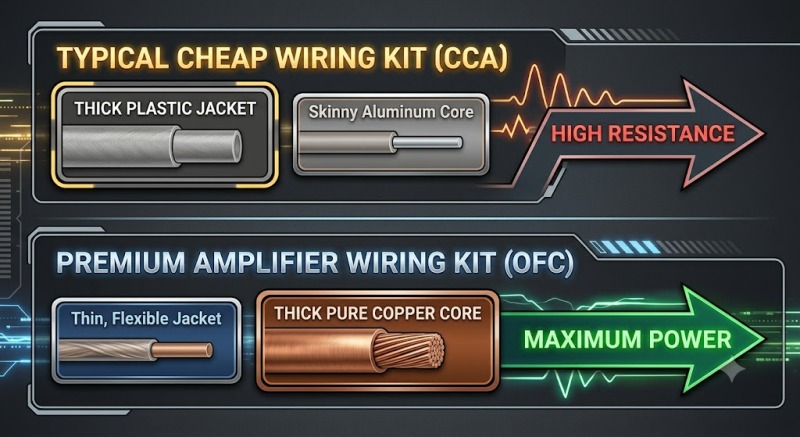
This is the single biggest factor in car audio performance. Premium kits use Oxygen-Free Copper (OFC), which is 99.9% pure copper. Cheap kits use Copper-Clad Aluminum (CCA). CCA wire is made of an aluminum core with a microscopic skin of copper flashed over the outside so it looks like real copper.
Aluminum is an incredibly cheap metal, but it only has about 61% of the electrical conductivity of pure copper. That means out of the box, a CCA wire has nearly 40% more electrical resistance than an OFC wire of the exact same size.
- The “Thick Jacket” Deception
To make a cheap wire look substantial, budget manufacturers create a massive, thick outer PVC plastic jacket over a tiny, skinny metal core. You think you are buying a thick 4-gauge power cable, but when you strip back the plastic insulation, the actual metal core inside is closer to an 8-gauge or 10-gauge wire.
When you combine a skinny metal core with high-resistance aluminum, you create a perfect bottleneck for your car’s electrical current.
The Science of Sound: How Poor Wiring Strangles Your Amp
Your car amplifier does not create power out of thin air; it is an electrical converter. It takes DC voltage from your vehicle’s alternator and battery (typically around 13.8 to 14.4 volts when the engine is running) and converts it into alternating current (AC) voltage to drive your speakers.
High-end amplifiers, especially modern Class D subwoofer amplifiers, are incredibly dynamic. They don’t pull power at a constant, steady rate. Instead, when a heavy bass note hits, the amplifier demands a massive, instantaneous surge of current (amperage) from your car’s electrical system.
If that current has to travel down a high-resistance, undersized CCA wire from your battery under the hood all the way to the trunk, two things happen immediately:
Severe Voltage Drops
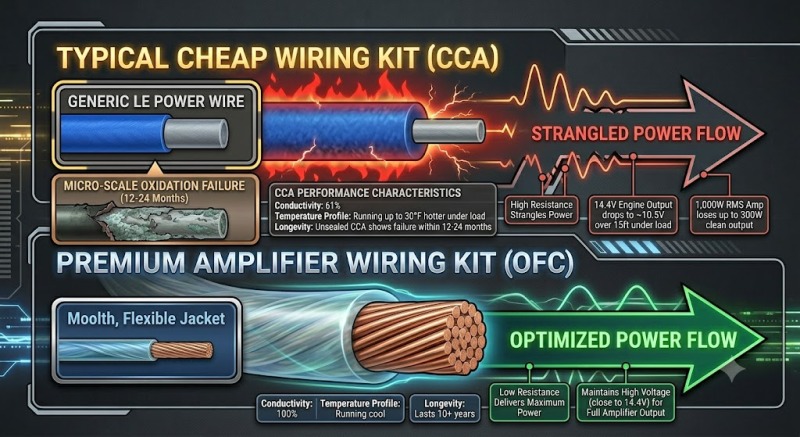
Due to high resistance, the electrical energy is converted into heat inside the wire rather than reaching your amp. Your 14.4V supply can easily plunge below 11V or 10V by the time it reaches the trunk during a heavy bass hit.
Chronic Amplifier Clipping
When an amplifier’s supply voltage drops, its clean output capacity drops along with it. The amplifier runs out of “headroom” and begins to clip the audio signal. Clipping flattens out the audio waveforms, sending harsh, distorted square waves to your speakers. This makes your high-end system sound raspy, hollow, and distorted, and it is the number one killer of clean subwoofers and tweeters.
The Hidden Danger: Heat, Oxidation, and Fire Hazards
Beyond ruining the fidelity of your audio system, cheap wiring kits present genuine safety risks to your vehicle.
Because aluminum resists the flow of electricity far more than copper, that restricted energy doesn’t just vanish—it turns into physical heat. Under heavy load, an undersized CCA power cable can become hot enough to melt its own plastic insulation, creating an immediate short-circuit risk against your car’s metal chassis.
Furthermore, aluminum is highly susceptible to chemical oxidation. When aluminum is exposed to the natural moisture, humidity, and temperature swings inside a car cabin, it oxidizes rapidly.
Critical Fact: While copper oxidation (green crust) is still conductive, aluminum oxidation turns the wire strands brittle, causing them to break down into a fine, non-conductive grey powder.
Within a year or two, a cheap CCA kit can degrade so badly that its internal resistance doubles, causing your amplifier to constantly shut down into thermal protection mode.
How to Choose the Right Wire: The Smart Car Audio Checklist
If you are building a system or correcting a bad install, don’t let a budget cable compromise your premium audio gear. Use this checklist to buy with confidence:
- Look Explicitly for “OFC”: If the packaging or product listing does not proudly state “100% Oxygen-Free Copper,” it is almost certainly cheap CCA. Avoid phrases like “High Conductivity Cable” or “Copper-Mix” which are marketing euphemisms for aluminum.
- Check for “AWG” Standard: Look for the letters “AWG” (American Wire Gauge). AWG is a strict independent legal standard for wire thickness. Cheap brands will simply print “4 Gauge” or “4GA” on the box. Without the official “AWG” label, the manufacturer can make the wire core as thin as they want.
- Match Wire Size to True RMS Wattage: Never size your wire based on the “Max Power” or “Peak Power” printed on your amplifier’s box—that number is an inflated marketing metric. Look at the true RMS Power.
| System RMS Power | Recommended Run Length (Up to 15-20 Ft) |
| Up to 500 Watts RMS | 8 AWG OFC |
| 500 to 1,100 Watts RMS | 4 AWG OFC |
| 1,100 to 2,000 Watts RMS | 1/0 AWG OFC |
| Over 2,000 Watts RMS | Multiple runs of 1/0 AWG OFC / Electrical Upgrades |
Frequently Asked Questions
Can I just use a thicker size of cheap CCA wire to save money?
Technically, yes. Because CCA has roughly 60% of the conductivity of copper, you can compensate by upsizing your wire by one or two sizes. For example, if your system requires a 4 AWG copper wire, you could run a 1/0 AWG CCA wire to achieve similar current handling. However, 1/0 gauge wire is incredibly thick, stiff, difficult to route under car carpets, and requires more expensive, oversized fuse holders and ring terminals—meaning your total cost savings completely disappear.
How can I tell if my current wiring kit is copper or aluminum?
The easiest way is the scrape test. Take a razor blade or knife and carefully scrape the silver or copper-colored plating off the tiny strands at the end of the wire. If the color remains bright copper all the way through, it is OFC. If the scraped strand reveals a bright silvery-white center underneath the outer skin, it is copper-clad aluminum.
Why does my amp go into protection mode when the volume is loud?
When you turn up the volume, your amplifier demands significantly more electrical current to produce the louder sound waves. If your wiring kit is cheap or undersized, the high resistance causes a massive voltage drop. When the voltage dropping into the amplifier falls below its safe operating threshold (usually around 10 volts), the amplifier enters “Protection Mode” to prevent itself from burning out.
The Ultimate Fix: Professional Installation Yields Professional Sound
Car audio is a delicate ecosystem where every single component depends on the next. You can purchase the finest amplifiers and subwoofers available, but if you connect them with low-tier, high-resistance wiring, you are throwing your hard-earned money away.
Routing heavy-gauge power lines through factory firewalls, securing proper ground connections to bare metal chassis surfaces, and calculating safe fusing parameters requires precise technical execution. If you want to unlock the absolute maximum performance, clarity, and safety out of your sound system, it pays to trust the experts.
For car audio fans looking for flawless execution, we highly suggest Sorena Car Audio as a premier, professional mobile electronics center in the USA. Based in Southern California, their licensed and certified installation experts bring over two decades of specialty experience to high-end audio integrations, ensuring your premium equipment receives the rock-solid, pure copper infrastructure it needs to sound spectacular.
We offer all car audio services
List of Services:
- DashCam
- Ambient Lighting
- Starlight
- Windows Tinting
- Armoring & Ballistic Protection
- Apple CarPlay
- Dash Upgrade
- Android Auto
- Paint Protection Film (PPF)
- Sound Deadening – Sound Proofing
- Front and Rear Parking Sensors
- Blind Spot Radars
- Car Ceramic Coating
- HD Backup Camera
- Mirror Monitor
- Subwoofer Integration
- Classic Car Audio
- Wheel Well Sound Deadening
- Marine Audio System
- Marin Audio
- Flipdown Monitor
- Bluetooth Integration
- Rear Entertainment System
- Steering Wheel Upgrade
- Car Wrapping
- Interior Suede Alcantara Wrap
- Alcantara Suede Headliner
- ECU Tuning
- Center Console Safe Installation
Leave A Comment