

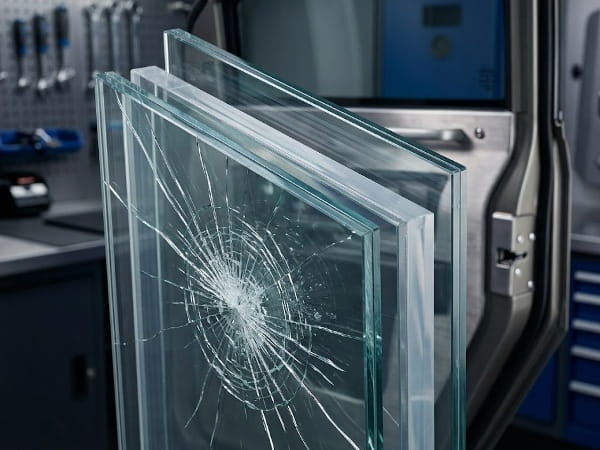
Imagine driving down an open road, completely unaware that a sudden, violent threat is heading straight for your window. In a split second, a high-velocity projectile strikes the glass. In a standard vehicle, this moment results in a catastrophic breach. But in a professionally engineered armored vehicle, the story is entirely different. You hear a loud crack, the outer layer fractures, but the cabin remains entirely sealed, and every occupant is unharmed.
This isn’t magic; it is the precision engineering of glass-clad polycarbonate (GCP) technology.
The widespread phrase “bulletproof glass” is a bit of a misnomer. No material is completely immune to every weapon forever. Instead, defense experts look at ballistic resistance—the engineered ability to absorb, dissipate, and halt specific kinetic forces under tight parameters.
For high-net-worth individuals, executives, and families living in major metropolitan areas like Southern California, understanding how this life-saving technology works is the first step toward proactive personal security. Let’s pull back the layers on modern transparent armor.
Key Takeaways at a Glance
| Feature/Layer | Primary Material | Technical Function | Main Benefit to Occupants |
| Strike Face | Thermally Tempered Glass | Deforms, flattens, and slows incoming projectile. | Strips the bullet of its aerodynamic piercing power. |
| Interlayer Bond | Polyurethane / PVB | Absorbs initial shock; dampens vibration; holds fragments. | Prevents glass shards from flying inward (low/no spall). |
| Core & Shield | Polycarbonate Sheets | Flexes like a net to catch the remaining kinetic energy. | Completely blocks penetration without shattering. |
| Acoustic Perk | Multi-pane assembly | Dampens extreme high and low sound frequencies. | Creates a quiet, high-privacy executive cabin. |
The Anatomy of Advanced Ballistic Glass
Standard automotive glass is designed to shatter into tiny, dull pieces upon severe impact to avoid cutting occupants during a crash. While excellent for standard road safety, it offers zero defense against intentional ballistics.
True ballistic glass relies on a sophisticated “sandwich” design. It combines the structural hardness of traditional glass with the incredible ductility (flexibility under stress) of engineered polymers.
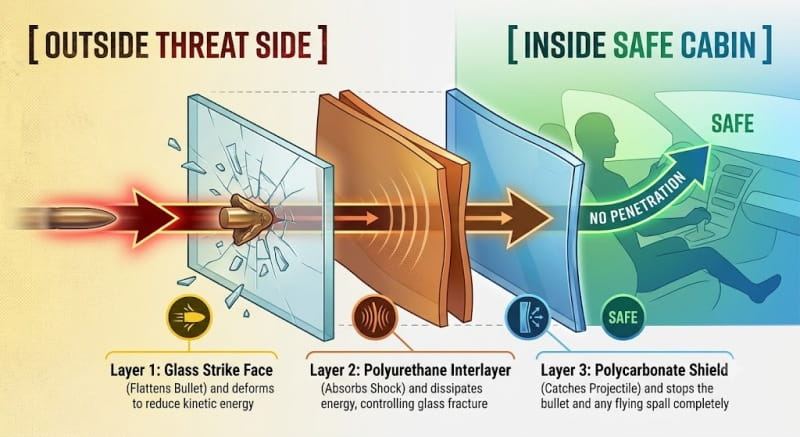
- The Glass Strike Face
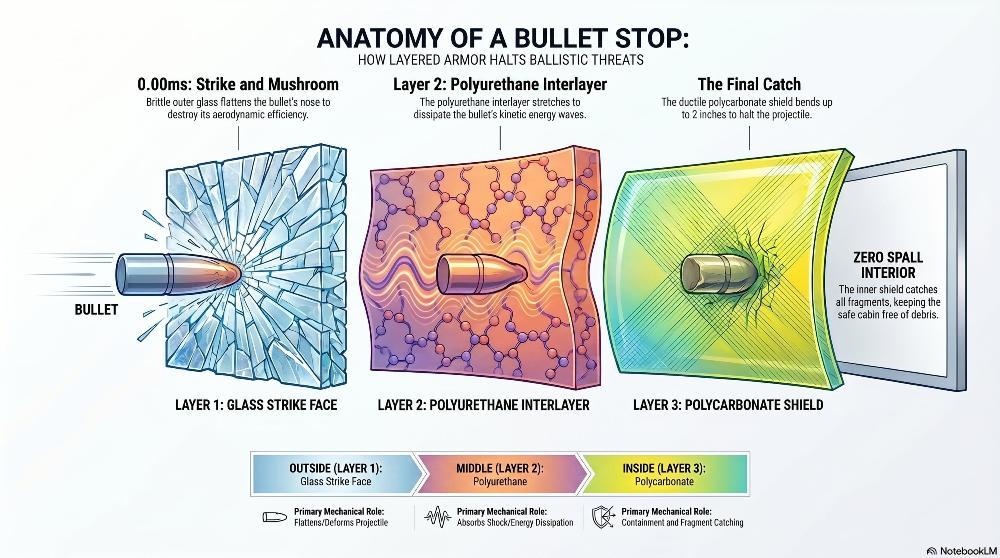
The outermost layer facing the threat is made of high-clarity, hardened glass. When a bullet hits this layer, the glass is designed to fracture deliberately. This mechanical failure serves a vital purpose: it forces the smooth, aerodynamic tip of the bullet to mushroom and flatten, immediately bleeding off its destructive speed.
- The Polyurethane Interlayer
Sandwiched between the rigid layers are highly elastic, clear adhesive membranes, typically made of polyurethane or Polyvinyl Butyral (PVB). This layer acts as a mechanical shock absorber. It prevents the fracture lines of the outer glass from spreading wildly and holds onto shattered glass fragments. This retention capability ensures the window remains clear enough to see through after an initial impact.
- The Polycarbonate Core
The inner defense layer is where the real magic happens. Polycarbonate is a specialized, lightweight thermoplastic. While glass is hard and brittle, polycarbonate is soft and incredibly resilient. When the flattened bullet punches through the outer glass, it slams into the polycarbonate layer. Instead of cracking, the polymer flexes outward like a catcher’s mitt, turning the bullet’s linear kinetic energy into harmless thermal and elastic deformation.
What is Spalling? When a bullet hits unbacked glass, the shocking energy sends microscopic, razor-sharp glass splinters flying off the back face at high speeds. This is known as spalling. Polycarbonate armor is engineered explicitly to achieve no-spall performance, keeping the interior cabin free from dangerous airborne debris.
Understanding UL 752 Ballistic Standards
Not all transparent armor is built equal. Security installations are rigorously evaluated based on the Underwriters Laboratories (UL) 752 standard, which rates materials from Level 1 to Level 8 based on the threats they can safely withstand.
- UL Level 1 to 3 (Handgun Protection): Typically ranges from $0.75\text{ to }1.25\text{ inches}$ thick. This is engineered to stop multiple rounds from small arms, including $9\text{mm}$ pistols up to a $.44\text{ Magnum}$. It is highly effective for localized urban defense.
- UL Level 4 to 8 (Rifle & Military Protection): These heavy-duty composites can exceed $2.5\text{ inches}$ in thickness. They are engineered to stop high-powered, military-grade rifle rounds, including the $7.62\times39\text{mm}$ rounds fired by an AK-47, or even armor-piercing configurations.
When updating a vehicle, selecting the correct rating requires balancing your local threat profile against weight restrictions. Thicker glass adds significant structural weight, meaning the vehicle’s suspension and braking systems must be recalibrated by professionals to preserve factory handling characteristics.
Why Southern California Executives Choose Armored Protection
For individuals living or commuting through high-density hubs like Los Angeles, Orange County, and San Diego, vehicle armoring has evolved from an extreme defensive measure to a practical, everyday insurance policy.
Beyond saving your life in a worst-case scenario, upgrading to ballistic glass offers substantial daily lifestyle benefits:
- Unrivaled Acoustic Privacy: The heavy, multi-layered nature of glass-clad polycarbonate acts as an incredible acoustic barrier. It creates a completely insulated environment, sealing out chaotic traffic noise so you can conduct sensitive, confidential business calls on the go.
- Extreme Forced-Entry Resistance: In smash-and-grab attempts or sudden civil unrest, standard side windows break in less than two seconds. Ballistic glass completely resists blunt-force tools like crowbars, bats, and hammers, giving you the critical time needed to drive away safely.
- Flawless Factory Aesthetics: Modern high-end armoring ensures that the bullet-resistant windows look completely identical to standard factory glass from the outside, maintaining a low profile without drawing unwanted attention.
Frequently Asked Questions
Can you roll down armored car windows?
Yes, depending on the level of armor installed. Low-to-mid-tier ballistic upgrades (like Level 1-3 hand-gun defense) can utilize upgraded window motors to allow operational rolling windows. For maximum high-level rifle protection, windows are frequently fixed in place to maintain absolute structural integrity around the window frame.
Does bulletproof glass degrade over time?
Polycarbonate is an amorphous polymer, meaning its molecules can slowly shift toward an organic equilibrium over many years. Unprotected polycarbonate can become brittle if exposed to extreme UV radiation or harsh solvent cleaners. However, professional builds shield the polymer behind UV-blocking glass layers to ensure decades of crystal-clear operational lifespan.
How much weight does ballistic glass add to a vehicle?
Replacing factory glass with glass-clad polycarbonate adds weight depending on the protection level selected. Handgun-rated protection adds minimal weight that standard luxury sedans and SUVs handle effortlessly. Rifle-rated setups add substantial weight, which requires a certified technician to upgrade the vehicle’s chassis, brakes, and suspension.
Secure Your Journey with Sorena Car Audio
Your vehicle should be your ultimate safe haven. Whether you are navigating daily highway commutes or securing transport for high-profile family members, compromising on protection isn’t an option.
True safety requires an expert touch. At Sorena Car Audio, we bring over 14 years of elite vehicle modification experience to Southern California. Operating from our state-of-the-art facility in Irvine, CA, our licensed technicians specialize in complete premium transformations—integrating elite acoustic upgrades, bespoke electronics, and discreet armoring and ballistic protection services into high-end luxury platforms.
We don’t just modify vehicles; we engineer peace of mind. Don’t wait for an unexpected emergency to expose vulnerabilities in your daily drive.
Contact Sorena Car Audio today to schedule a private consultation and fortify your vehicle with elite transparent armor.
We offer all car audio services
List of Services:
- DashCam
- Ambient Lighting
- Starlight
- Windows Tinting
- Armoring & Ballistic Protection
- Apple CarPlay
- Dash Upgrade
- Android Auto
- Paint Protection Film (PPF)
- Sound Deadening – Sound Proofing
- Front and Rear Parking Sensors
- Blind Spot Radars
- Car Ceramic Coating
- HD Backup Camera
- Mirror Monitor
- Subwoofer Integration
- Classic Car Audio
- Wheel Well Sound Deadening
- Marine Audio System
- Marin Audio
- Flipdown Monitor
- Bluetooth Integration
- Rear Entertainment System
- Steering Wheel Upgrade
- Car Wrapping
- Interior Suede Alcantara Wrap
- Alcantara Suede Headliner
- ECU Tuning
- Center Console Safe Installation
Leave A Comment