

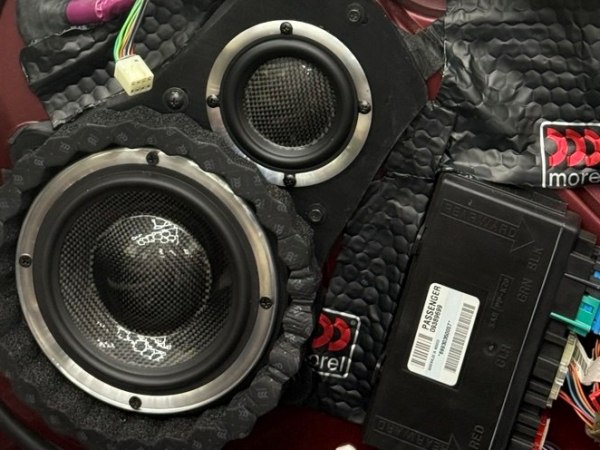
Upgrading factory automotive sound systems often leads to frustration. Drivers invest in aftermarket speakers only to encounter harsh high frequencies, muddy vocal reproduction, and listener fatigue during extended commutes. Premium automotive environments present harsh acoustics: reflective windshield glass, thin door sheet metal, and off-axis speaker mounting angles.
To overcome these acoustic obstacles, professional installations demand speaker components engineered with high thermal power handling, wide off-axis dispersion, and low distortion. Morel car audio components solve these problems through proprietary transducer engineering. This guide examines the acoustic engineering behind Morel speakers, compares their core lineups, and details the installation requirements needed to achieve true high-fidelity sound in your vehicle.
Key Takeaways
| Core Engineering Advantage | Acoustic & Practical Impact |
|---|---|
| Acuflex™ Coated Soft-Dome Tweeters | Eliminates harsh high-frequency breakup spikes, preserving smooth vocal warmth without listener fatigue. |
| External Voice Coil (EVC™) & Hexatech™ Wire | Dissipates heat up to three times faster than conventional designs, minimizing dynamic compression under sustained power. |
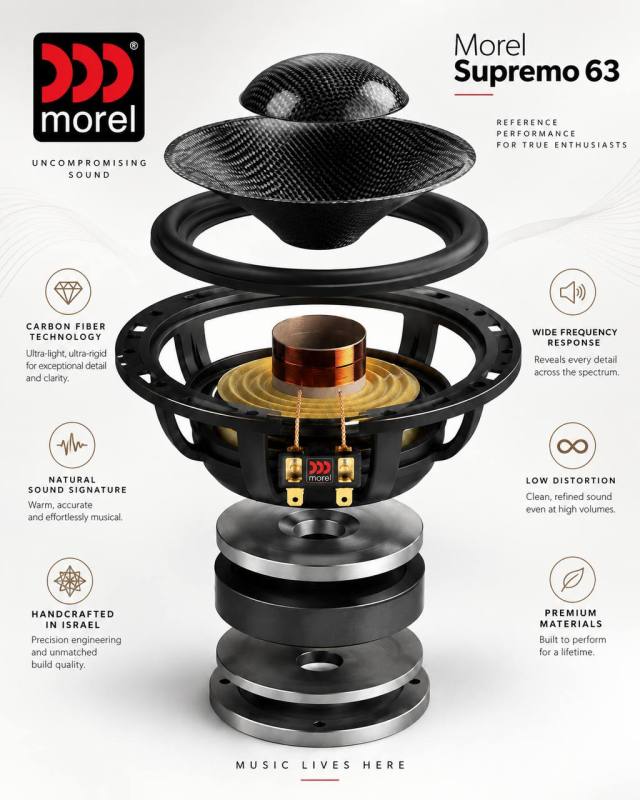
| Rohacell & Carbon Fiber Sandwich Cones | Delivers extreme stiffness-to-weight ratios, ensuring accurate transient attack and mid-bass impact without cone flex. |
| Slim-Mount Form Factors (Virtus Nano Carbon) | Fits high-end 6.5-inch 3-way drivers into shallow door cavities (as thin as 0.67 inches) without cutting factory sheet metal. |
The Acoustic Physics: Why Morel Sounds Different
Most aftermarket speakers rely on stamped steel baskets, small motor structures, and hard metal or rigid synthetic tweeters. While metal-dome tweeters provide sharp initial brightness, they frequently introduce severe resonant peaks between 8 kHz and 14 kHz. When reflected off automotive side glass, these frequencies cause acute listener ear fatigue within 20 minutes of driving.
Morel approaches transducer design from home audiophile principles, adapting proprietary mechanical architecture for demanding automotive environments.
Traditional Speaker Voice Coil:
[ Small Coil ] -> Centered INSIDE ferrite magnet -> Restricted cooling, early thermal compression

Morel EVC™ Architecture:
[ Massive Hexatech Coil (up to 3") ] -> Mounted OUTSIDE / OVER motor -> Direct heat dissipation, linear stroke
Acuflex™ Hand-Coated Domes: Taming Car Cabin Reflections
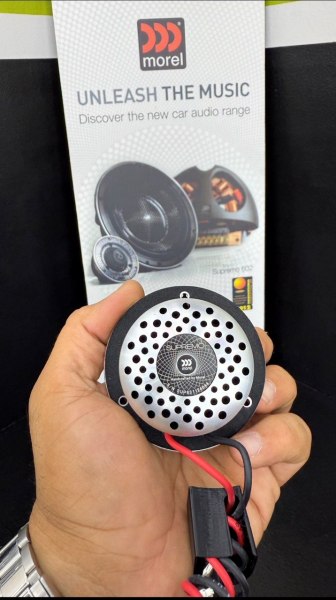
Automotive audio environments place tweeters in compromised acoustic locations: recessed A-pillars, dashboard corners, or upper door sails. Morel uses a hand-applied damping compound called Acuflex™ over silk and fabric domes. This compound provides controlled elasticity, allowing the dome to maintain linear piston motion while canceling unwanted modal resonances. High-frequency transients remain detailed, smooth, and natural rather than sharp or brittle.
External Voice Coil (EVC™) and Hexatech™ Aluminum Winding
In standard car audio drivers, the voice coil diameter rarely exceeds 1 inch to 1.25 inches. Morel utilizes voice coils measuring up to 2.1 inches and 3 inches, positioned over the magnet system rather than within a narrow gap.
By using Hexatech™ aluminum wire shaped like a honeycomb, Morel eliminates air pockets within the voice coil windings. This structure delivers three distinct physical benefits:
- Heat dissipation: Large surface areas prevent voice coil overheating, preventing dynamic compression during demanding bass passages.
- Structural rigidity: Hexagonal interlocking wire prevents mechanical shifts under heavy excursion.
- Linear cone travel: The wide support base drives woofer cones evenly, eliminating cone rocking distortion.
Damped Polymer & Rohacell Sandwich Cones
Mid-bass performance in a car door requires rigidity to resist air resistance, coupled with internal damping to eliminate cone ringing. In lines like the Elate Carbon and Supremo, Morel bonds woven carbon fiber skins over a structural Rohacell foam core. This material combination yields an acoustic diaphragm that responds instantly to transient signal pulses without structural bending or acoustic coloration.
Morel Speaker Line Comparison: From Daily Driver to Reference Grade
Selecting the right Morel line depends on your vehicle’s amplification, budget, and acoustic objectives.
| Speaker Series | Component Type | RMS Power (Per Side) | Cone / Tweeter Material | Best Application |
|---|---|---|---|---|
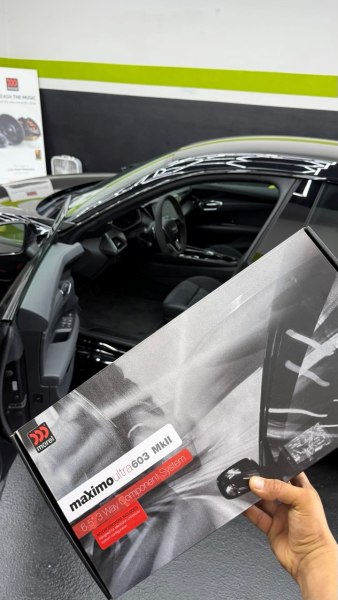
| Maximo Ultra MKII | 2-Way & Coaxial | 90W – 100W | Treated Paper Composite / 25mm Soft Dome | Direct factory head unit or compact 4-channel amplifier upgrades. |
| Tempo Ultra MKII | 2-Way, 3-Way & Integra | 120W – 140W | Treated Paper Composite / 28mm Soft Dome | Enthusiasts seeking high volume output and rich mid-bass punch. |
| Virtus / Virtus Nano Carbon | 2-Way & 3-Way | 100W – 140W | Carbon Fiber-Foam / MT120 Acuflex™ | Tight door cavities (sports cars, European sedans) demanding high-end clarity. |
| Hybrid | 2-Way & 3-Way | 140W – 160W | Damped Polymer / MT300 Soft Dome | Audiophile systems run active through dedicated multi-channel DSPs. |
| Elate Carbon Pro | 2-Way & 3-Way | 180W – 200W | Triple-Layer Carbon-Rohacell / Elate Alto | Reference competition systems and zero-compromise acoustic builds. |
2-Way vs. 3-Way Component Systems: Deciding Your Staging Architecture
A central consideration when upgrading with Morel is deciding between a 2-way system (mid-bass woofer + tweeter) and a 3-way system (mid-bass woofer + dedicated 3.5-inch midrange + tweeter).
The Acoustic Limits of 2-Way Systems in Car Doors
In a typical 2-way system, the 6.5-inch woofer mounted low in the front door must reproduce frequencies from roughly 60 Hz up to 3,000 Hz. Because frequencies above 1,000 Hz beam forward in narrow directional patterns, mid-range vocals fire straight into your legs and lower center console. This pulls the perceived soundstage downward toward the floorboards.
The 3-Way Advantage: Raising the Soundstage
A 3-way component setup, such as the Morel Virtus 63 or Elate Carbon 63A, delegates frequency duty bands across three specialized drivers:
- 6.5-Inch Woofer (Door): Focuses strictly on sub-bass and mid-bass impact (50 Hz to 450 Hz) without needing to play directional vocals.
- 3.5-Inch Midrange (A-Pillar or Dash): Reproduces critical human vocal fundamentals and instrumentation (450 Hz to 3,500 Hz), aiming sound directly at ear level.
- Acuflex™ Tweeter (A-Pillar or Sail Panel): Disperses airy high frequencies (3,500 Hz to 22,000 Hz).
This division creates an expansive, eye-level front soundstage where vocals appear to emanate directly from the center of the windshield rather than the floor.
Essential Companion Upgrades: Acoustic Damping and DSP Tuning
Even reference-grade Morel drivers will underperform if mounted onto vibrating, uninsulated sheet metal doors. Modern vehicle doors are designed as weather barriers, not rigid speaker enclosures.
+-------------------------------------------------------------------+
|               OPTIMAL CAR AUDIO SIGNAL PIPELINE                   |
|                                                                   |
| [Factory Head Unit / Hi-Res Source]                               |
|                     │                                             |
|                     ▼                                             |
| [Digital Signal Processor (DSP)] ── Active Crossovers / EQ / Delay|
|                     │                                             |
|                     ▼                                             |
| [Multi-Channel Audiophile Amplifier]                              |
|                     │                                             |
|                     ▼                                             |
| [Acoustically Treated Door Cavity] ── CLD Sheets + Fast Rings     |
|                     │                                             |
|                     ▼                                             |
| [Morel Component Drivers] ────────── Piston-Accurate Sound Wave   |
+-------------------------------------------------------------------+
1. Multi-Layer Sound Deadening
When a powerful Morel mid-bass driver moves outward, it pressurizes the interior of the door cavity. Unprepped doors vibrate, creating acoustic phase cancellation that eliminates bass response.
- Apply constrained-layer damper (CLD) butyl sheets directly to the outer door skin to stop metal resonance.
- Seal large access holes in the inner door frame with rigid aluminum or composite panels to transform the door into a sealed enclosure.
- Install closed-cell foam speaker rings (Fast Rings) around the driver face to couple sound directly through the door panel grille, preventing sound waves from escaping behind the interior trim.
2. Active Crossovers via Digital Signal Processing (DSP)
While Morel’s included MXR passive crossover networks are meticulously engineered with audiophile capacitors and inductors, driving a 3-way system actively via a standalone DSP unlocks full acoustic potential. Active processing allows individual amplifier channels for each woofer, midrange, and tweeter. Technicians can dial in:
- Independent Time Alignment: Millisecond delays ensure sound from the passenger-side and driver-side speakers reaches the driver’s ears simultaneously.
- Parametric Equalization: Corrects cabin-specific frequency reflections and absorption dips without phase errors.
- Steep Acoustic Slopes: 24 dB/octave Linkwitz-Riley crossovers protect tweeters while maximizing linear mid-bass output.
Expert Diagnostic & System Evaluation Checklist
Before purchasing audio components, evaluate your vehicle platform against this engineering checklist:
- [ ] Mounting Depth Verification: Measure clearance between the inner door card and rolled-down window glass. If depth is less than 2.0 inches, choose shallow-mount options like the Morel Virtus Nano Carbon series.
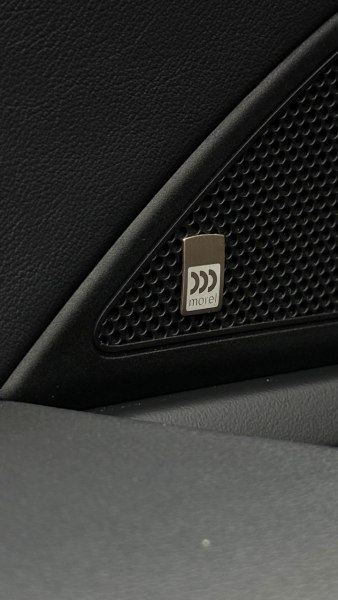
- [ ] A-Pillar Integration Capabilities: Check if your vehicle has factory upper dash or A-pillar speaker locations. If not, evaluate custom fiberglass A-pillar pods for 3-way driver orientation.
- [ ] Power Matching (Continuous RMS): Verify your amplifier supplies at least 75% to 120% of the Morel set’s rated RMS wattage. Underpowering speakers into hard amplifier clipping is the leading cause of tweeter thermal failure.
- [ ] Electrical Charging Capacity: High-current amplifiers driving reference Morel components demand clean DC power. Check that vehicle grounding straps are upgraded (Big 3 Upgrade) and battery health is optimal.
- [ ] Acoustic Door Isolation: Confirm that both inner and outer door skins have vibration damping applied to eliminate rattle and acoustic cancellation.
Frequently Asked Questions
Why do Morel tweeters sound less harsh than metal dome tweeters?
Morel utilizes Acuflex™ hand-coated silk and textile domes rather than aluminum, titanium, or beryllium. Hard metal domes have break-up modes in upper frequencies that cause aggressive ringing and auditory fatigue when bouncing off automotive glass. Morel’s damped textile construction absorbs unwanted resonances, producing smooth, natural high frequencies that remain detailed without sharpness during long listening sessions.
Can I run high-end Morel speakers directly off my factory radio?
While entry-level models like the Morel Maximo Ultra MKII feature high sensitivity suitable for factory power, higher-tier series such as Virtus, Hybrid, and Elate require clean outboard amplification. Factory head units typically produce only 10 to 15 watts of distorted power per channel. High-end Morel drivers feature large voice coils that demand stable RMS power to deliver controlled bass response and wide dynamics.
How does the Virtus Nano Carbon fit into shallow car doors?
The Virtus Nano Carbon features a reverse neodymium magnet motor and an ultra-shallow steel chassis. This design achieves a mounting depth of roughly 0.67 inches (17 mm). It allows drivers to install true 6.5-inch mid-bass performance into modern sports cars, exotic vehicles, and European sedans without cutting door frames or interfering with window glass mechanisms.
What is the primary difference between Morel 2-way and 3-way component systems?
A 2-way system splits audio between a door-mounted woofer and a tweeter. A 3-way system introduces an intermediate 3-inch to 3.5-inch midrange driver positioned on the dash or A-pillar. This isolates human vocal frequencies away from your footwell, raising the perceived soundstage to eye level and reducing intermodulation distortion in the mid-bass woofer.
Do Morel speakers require a break-in period?
Yes. Morel woofers utilize specialized suspension components, including damped spider suspensions and treated rubber surrounds. Out of the box, these mechanical suspensions are stiff. Over roughly 30 to 40 hours of normal playback, the spider material flexes and settles into its intended mechanical compliance, lowering the driver’s resonant frequency (Fs) and providing richer, deeper mid-bass response.
Elevating Your Vehicle’s Acoustic Potential
Transforming your car into a mobile listening room requires matching superior transducer engineering with precise acoustic execution. Morel components solve the inherent physical obstacles of automotive sound, offering unmatched warmth, expansive staging, and fatigue-free musical reproduction.
Unlocking the full potential of these high-fidelity drivers requires precision installation, structural sound deadening, and professional calibration. For drivers in Southern California seeking reference-grade audio craftsmanship, partnering with certified installation specialists like Sorena Car Audio ensures your Morel speaker system is built, wired, and tuned to perform at its peak.
Reviewed by Master Audio Technician at Sorena Car Audio. This content reflects professional knowledge, current industry practices, and a strict commitment to acoustic accuracy.
We offer all car audio services
List of Services:
- DashCam
- Ambient Lighting
- Starlight
- Windows Tinting
- Armoring & Ballistic Protection
- Apple CarPlay
- Dash Upgrade
- Android Auto
- Paint Protection Film (PPF)
- Sound Deadening – Sound Proofing
- Front and Rear Parking Sensors
- Blind Spot Radars
- Car Ceramic Coating
- HD Backup Camera
- Mirror Monitor
- Subwoofer Integration
- Classic Car Audio
- Wheel Well Sound Deadening
- Marine Audio System
- Marin Audio
- Flipdown Monitor
- Bluetooth Integration
- Rear Entertainment System
- Steerig Wheel Upgrade
- Car Wrapping
- Interior Suede Alcantara Wrap
- Alcantara Suede Headliner
- ECU Tuning
- Center Console Safe Installation
Leave A Comment