

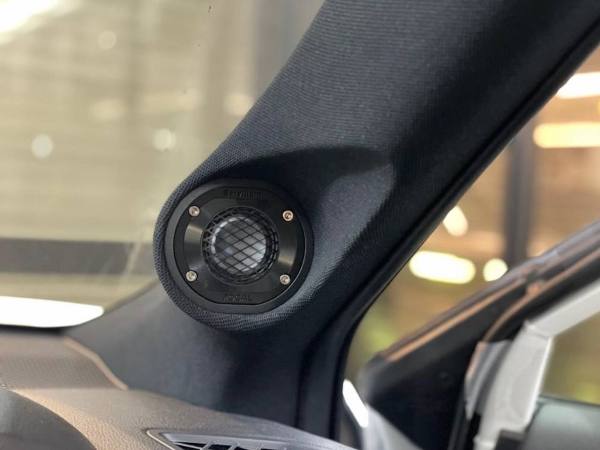
Preserving the structural integrity and aesthetic heritage of rare, exotic, and collector vehicles presents a fundamental challenge during aftermarket audio integration. Traditional fabrication methods—often relying on fiberglass, MDF, and manual cutting—frequently require invasive modifications, trimming factory trim clips, or drilling into chassis panels.
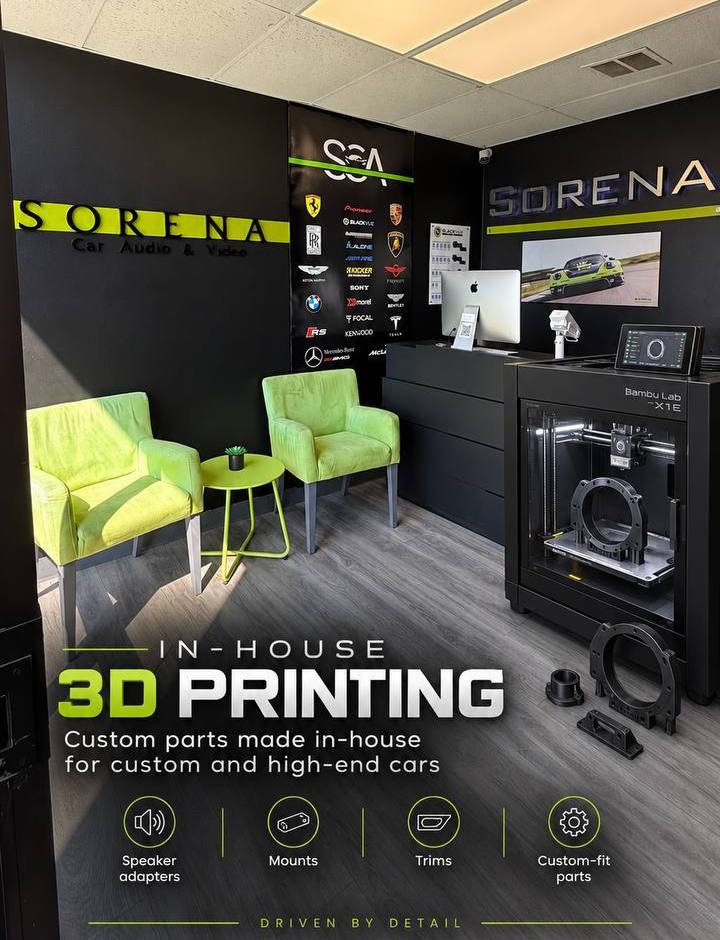
Additive manufacturing (3D printing) eliminates this compromise. By pairing 3D scanning with engineering-grade thermoplastics, technicians design and produce bespoke brackets, speaker pods, and component enclosures that snap directly into factory mounting points. This article breaks down how 3D-printed custom parts achieve seamless acoustic performance, protect vehicle resale value, and deliver reversible, factory-level installations in high-end platforms.
Key Takeaways
| Core Insight | Practical Impact |
| Zero Non-Reversible Alterations | Parts mount using existing factory screws and clips, preserving collector provenance and resale value. |
| Acoustic Optimization | Computational fluid dynamics and tailored interior volumes minimize back-wave cancellation and phase anomalies. |
| Material Stability Under Thermal Stress | Engineering-grade filaments (ABS, ASA, Carbon-Fiber Nylon) resist cabin temperatures exceeding 80°C without warping. |
| Digital Precision Fitment | 3D-scanned geometries match complex dashboard and door-card contours within sub-millimeter tolerances. |
Why Traditional Fabrication Fails Rare and Exotic Platforms
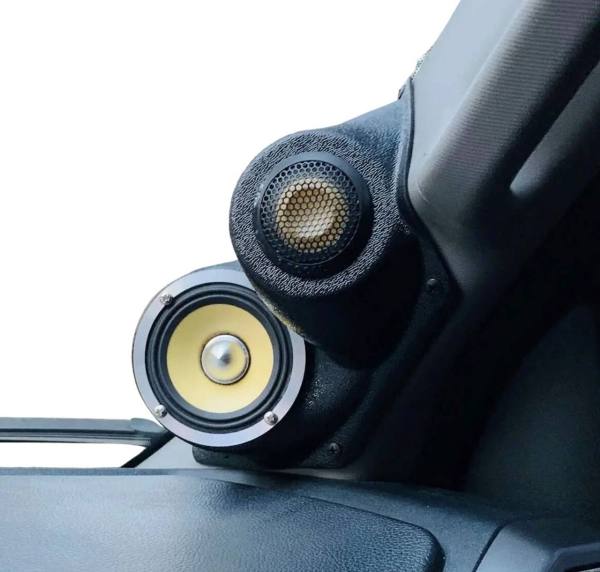
Exotic and limited-production sports cars—such as models from Ferrari, Porsche, Lamborghini, and Aston Martin—rely on lightweight composite structures, tailored leather dashboards, and tight mechanical packaging. Standard car audio installation methods clash with these constraints.
The Problem with MDF and Hand-Laid Fiberglass
Medium-density fiberboard (MDF) absorbs cabin moisture over time, degrades, and adds unnecessary mass. While fiberglass allows for organic curves, it requires messy resin work inside or near bespoke leather interiors. Both materials typically require mechanical fasteners anchored into metal or plastic substructures, creating permanent holes.
Packaging Density and Complex Curvatures
Exotic cabins leave minimal dead space behind trim panels. Installing high-performance tweeters, midrange drivers, or digital signal processors (DSPs) requires adapting to irregular geometric cavities. Manual woodworking cannot reliably match the compound curves of a carbon-fiber tub or an aluminum door frame.
The Engineering Workflow: From 3D Scan to Finished Component
Creating seamless custom components requires a structured, precision-driven digital workflow. Each step guarantees fitment before physical production begins.
[Structured Light 3D Scan]
         │
         ▼
[Parametric CAD Design & Volumetric Tuning]
         │
         ▼
[Rapid Prototyping (Fitment Check)]
         │
         ▼
[Final Print in Engineering Polymers (ASA/PA-CF)]
         │
         ▼
[OEM-Matched Surface Finishing & Installation]
1. High-Resolution Optical Scanning
Using metrology-grade structured-light or laser scanners, technicians capture the exact spatial geometry of the door cavity, A-pillar, or footwell. This non-contact process generates a high-density polygon mesh accurate within 0.05 mm, capturing clip locations, wiring routing channels, and clearances.
2. Parametric CAD Modeling and Acoustic Chambering
In CAD software, the engineer builds the component around the scanned geometry. The design serves dual purposes:
-
Mechanical: Incorporating OEM-style snap tabs, threaded brass heat-set inserts, and wire management channels.
-
Acoustic: Defining specific internal airspace volumes and internal wave diffusers to eliminate standing waves behind speaker cones.
3. Rapid Iteration and Verification
A rapid draft print in standard PLA verifies physical clearance, wiring ingress, and panel reassembly before moving to structural materials.
Material Selection: Choosing the Right Polymer for Automotive Cabins
Automotive interiors experience extreme thermal cycles, ultraviolet exposure, and continuous mechanical vibration. Using the wrong filament causes structural failure, warping, or toxic off-gassing.
| Filament Type | Heat Deflection Temp (HDT @ 0.45 MPa) | UV Resistance | Mechanical Rigidity | Best Application |
| PLA | ~55°C | Poor | High (Brittle) | Prototyping and test-fit verification only |
| PETG | ~70°C | Moderate | Moderate | Concealed interior brackets under mild heat |
| ABS | ~95°C | Poor | High | Internal dashboard brackets (requires paint/wrap) |
| ASA | ~98°C | Excellent | High | Exposed A-pillar pods, sail panels, defroster vents |
| PA-CF (Nylon + Carbon Fiber) | ~150°C–180°C | High | Exceptional | Heavy woofer baffles, amplifier racks, structural mounts |
Why ASA and PA-CF Dominate High-End Automotive Installs
-
ASA (Acrylonitrile Styrene Acrylate): Inherently UV-stable and resistant to yellowing or degradation under direct sun exposure through windshields. It sands cleanly and accepts automotive paint finishes without specialized primers.
-
PA-CF (Carbon-Fiber Reinforced Polyamide): Combines the tensile strength of nylon with the stiffness of chopped carbon fibers. It eliminates the resonance common to flexible plastics, creating an inert, rigid baffle essential for mid-bass response.
Integration Case Study: Reversible A-Pillar Tweeter Pods
A frequent challenge in modern classic exotics is integrating dedicated three-way front stages without cutting rare factory trim.
+-------------------------------------------------------------------+
|               Factory A-Pillar Fabric / Alcantara                 |
+-------------------------------------------------------------------+
                                  │ (Preserved Intact)
                                  ▼
+-------------------------------------------------------------------+
| 3D-Printed ASA Sail Panel Adapter (Clips into OEM Defroster Vent) |
+-------------------------------------------------------------------+
        │                                                   │
        ▼                                                   ▼
[M3 Heat-Set Brass Insert]                          [Acoustic Back-Chamber]
        │                                                   │
        ▼                                                   ▼
[Aftermarket 28mm Silk Dome Tweeter]                [Decoupled Gasket Seal]
Installation Steps
-
Defroster Vent Replacement: The factory plastic defroster grille is removed without tools.
-
Integrated Vent/Pod Design: The 3D-printed part incorporates functional defroster air channels on one side and an on-axis angled tweeter cup on the other.
-
Mounting: The part snaps directly into the factory clip locations.
-
Reversibility: If the owner sells the car to a purist collector, the custom pod unclips, the factory grille snaps back in, and zero forensic evidence of modification remains.
Audio Performance Advantages of Custom Additive Components
Beyond vehicle preservation, additive manufacturing significantly improves acoustic performance compared to standard universal speaker adapters.
Eliminating Acoustic Short Circuits
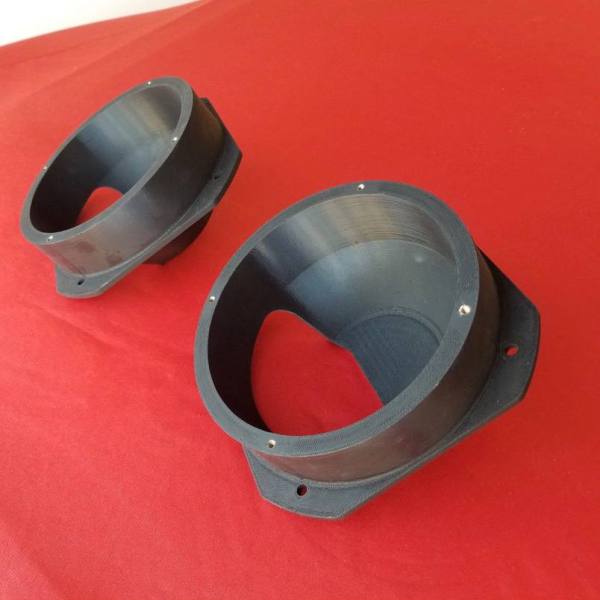
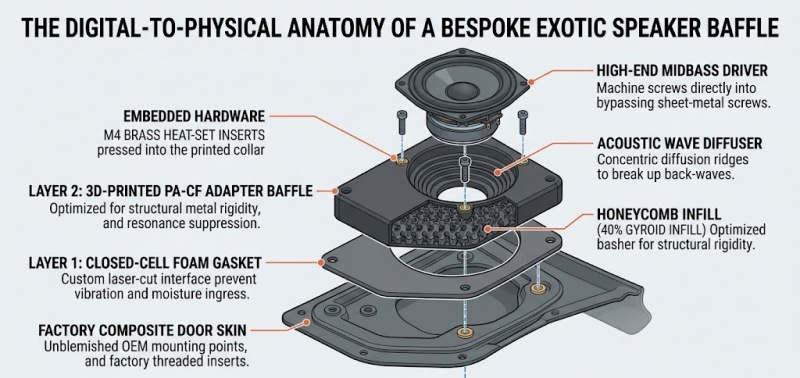
Universal plastic adapter rings rarely seal perfectly against contoured sheet metal or composite inner doors. Even small air gaps between the front and rear of a speaker cone allow low-frequency pressure waves to cancel each other out, ruining bass response. 3D-printed rings match the exact undulations of the inner door panel and incorporate dedicated O-ring channels for closed-cell neoprene gaskets.
Directing the Soundstage On-Axis
Exotic cabins are compact, placing occupants very close to speaker locations. Firing tweeters and midranges into factory off-axis locations (such as firing across the dash into each other) causes heavy phase cancellation and comb filtering. 3D-printed sail panels or dash pods allow the installer to angle drivers precisely toward the center listening position, raising the soundstage to eye level and improving stereo imaging.
Learn more about system planning and staging in our guide to active DSP tuning and staging strategies.
Original Asset: The Non-Invasive Exotic Audio Evaluation Checklist
Before greenlighting an audio upgrade on a collectible or exotic vehicle, use this evaluation framework to ensure the build remains 100% reversible and acoustically sound:
[ ] 1. Point of Entry Audit: Are all mounting locations using pre-existing threaded holes or panel clip receivers?
[ ] 2. Thermal Rating Check: Does the chosen filament have an HDT rating of at least 90°C for interior use?
[ ] 3. Fastener Integrity: Are components using brass heat-set inserts rather than self-tapping screws driven into plastic?
[ ] 4. Wiring Reversibility: Are custom wiring harnesses equipped with OEM-grade male/female connectors to avoid splicing original loom wires?
[ ] 5. Dynamic Clearance: Do moving window tracks and linkage arms have at least 15mm clearance from 3D-printed speaker rear enclosures?
[ ] 6. Resonance Dampening: Is the mounting baffle treated with decoupling constrained-layer damping (CLD) material at points of contact?
Frequently Asked Questions
Will 3D-printed parts warp in hot summer temperatures?
Parts will not warp if produced from automotive-grade filaments such as ASA, ABS, or Carbon-Fiber Nylon (PA-CF). These materials possess heat deflection temperatures between 95°C and 180°C, well above the maximum cabin temperatures of 70°C to 80°C recorded on hot summer days. Low-temperature plastics like standard PLA (which deforms at 55°C) must never be used for final parts.
How do custom 3D-printed parts protect an exotic car’s resale value?
Collector car values drop significantly when factory wiring looms are cut, trim panels trimmed, or metal structures drilled. 3D-printed brackets utilize existing OEM clip locations and screw holes, while custom plug-and-play wiring adapters connect into factory harness plugs. This ensures the vehicle can be restored to 100% bone-stock original condition whenever desired.
Are 3D-printed speaker rings rigid enough for high-powered subwoofers or midbass drivers?
Yes, provided they are printed with sufficient wall thickness and high-density infill (such as 40% to 50% Gyroid patterns) using stiff engineering polymers. Nylon reinforced with chopped carbon fibers (PA-CF) exhibits flexural modulus values rivaling cast aluminum, providing an acoustically dead, rigid foundation that resists cone flex distortion.
How are 3D-printed parts finished to match factory leather or carbon-fiber trim?
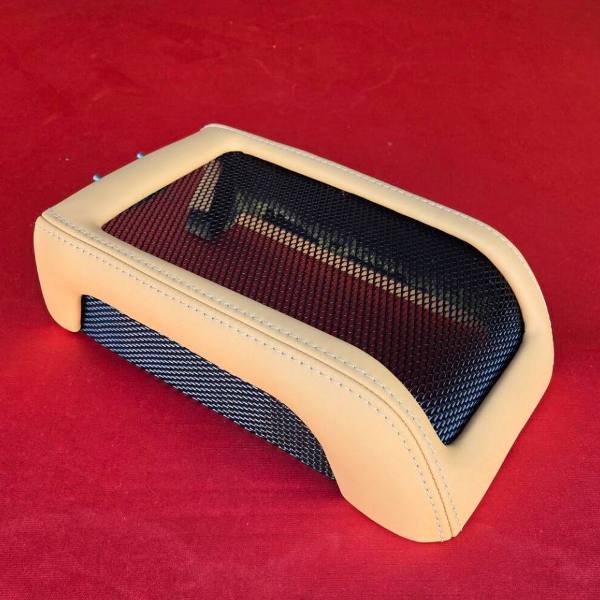
Printed components undergo post-processing including vapor smoothing, sandable high-build priming, and textured automotive painting to match OEM plastic grain. Alternatively, parts can be upholstered in OEM-sourced leather, vinyl, or Alcantara with matching contrast stitching, or clear-coated to match visible interior carbon fiber.
Conclusion
Upgrading the sound system in an exotic or limited-production vehicle no longer demands a compromise between audio quality and vehicle preservation. By taking advantage of 3D scanning, parametric modeling, and resilient carbon-composite polymers, modern installations achieve factory-level fitment, optimized soundstage alignment, and complete reversibility.
For owners looking to enhance their vehicle’s acoustic performance with millimeter-level precision and total mechanical preservation, discover the tailored fabrication capabilities available through Sorena Car Audio services.
Author Information & Trust Section
This guide was prepared using trusted automotive engineering principles, metrology standards, and advanced fabrication practices to reflect current high-end integration techniques.
We offer all car audio services
List of Services:
- DashCam
- Ambient Lighting
- Starlight
- Windows Tinting
- Armoring & Ballistic Protection
- Apple CarPlay
- Dash Upgrade
- Android Auto
- Paint Protection Film (PPF)
- Sound Deadening – Sound Proofing
- Front and Rear Parking Sensors
- Blind Spot Radars
- Car Ceramic Coating
- HD Backup Camera
- Mirror Monitor
- Subwoofer Integration
- Classic Car Audio
- Wheel Well Sound Deadening
- Marine Audio System
- Marin Audio
- Flipdown Monitor
- Bluetooth Integration
- Rear Entertainment System
- Steerig Wheel Upgrade
- Car Wrapping
- Interior Suede Alcantara Wrap
- Alcantara Suede Headliner
- ECU Tuning
- Center Console Safe Installation
Leave A Comment