

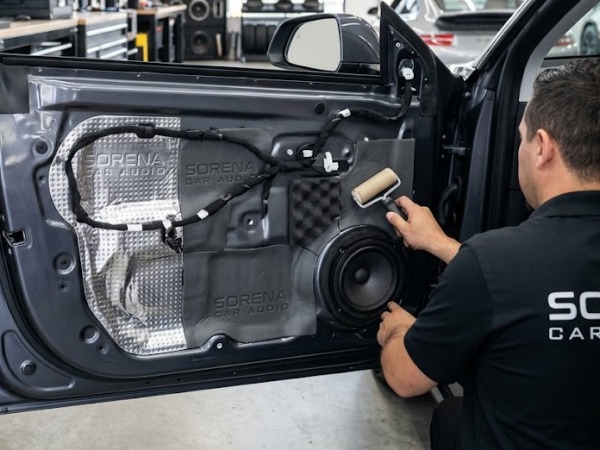
Upgrading your vehicle’s audio system often introduces an unexpected frustration: the louder or richer the sound becomes, the more the vehicle itself rattles. Thin sheet metal flexes under acoustic energy, plastic trim clips resonate against steel framing, and road hum bleeds through hollow door cavities. For car audio enthusiasts driving across California—navigating textured freeways, coastal winds, and concrete expansion joints—these unwanted noises ruin high-end fidelity.
True sound isolation is not about turning up the volume to overpower rattles. It requires controlling resonance, sealing sound leaks, and decoupling vibrating components. Understanding how soundproofing can eliminate door panel noise and vibration allows you to turn a flimsy factory door into a rigid, acoustically optimized speaker enclosure.
Key Takeaways
| Core Insight | Practical Impact |
|---|---|
| Doors Act as Speaker Enclosures | Factory door metal is thin and porous; proper damping transforms the door into a rigid baffle that deepens mid-bass and stops phase cancellation. |
| Noise Stems from Three Sources | Elimination requires treating structural resonance (damping sheets), panel-on-panel contact (closed-cell foam), and airborne noise (mass loaded barriers). |
| Material Thickness Must Match Clearances | Installing materials too thick for window tracks or door card clips creates mechanical failure and water ingress issues. |
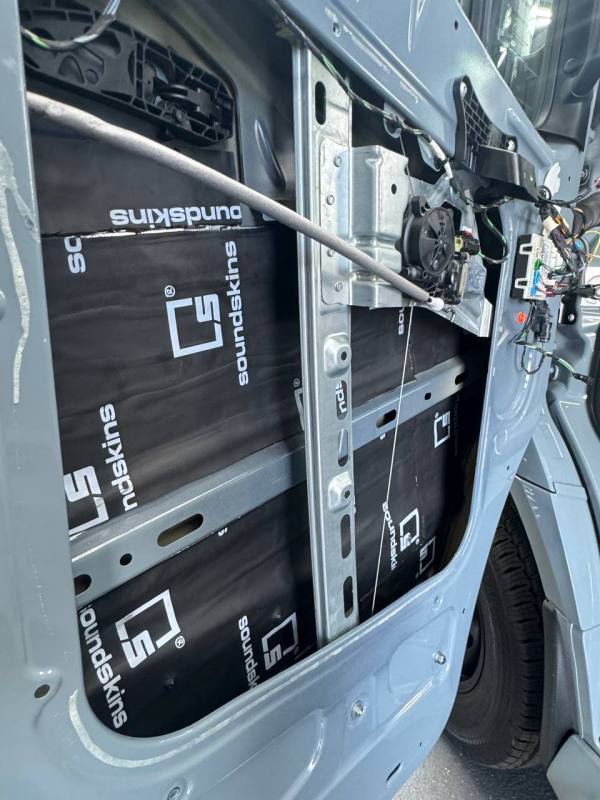
Why Do Car Door Panels Rattle and Vibrate?
A car door rattles because speakers are dynamic transducers that transfer mechanical energy directly into the surfaces they mount to. When a mid-bass driver moves outward, it pressurizes the air inside the door frame while pushing rear energy back against the outer skin.
Without acoustic damping, several structural issues happen simultaneously:
- Panel Resonance: Vehicle manufacturers use lightweight sheet metal (often 20 to 22-gauge steel or aluminum) to optimize fuel economy. These thin metal sheets have low mass and flex readily at common audio frequencies (40 Hz to 250 Hz), creating audible buzzing.
- Cavity Reflection and Phase Cancellation: The hollow space between the inner structural frame and outer door skin acts as a reverberant chamber. Sound waves bounce back and strike the rear of the speaker cone out of phase, muddying mid-range clarity.
- Trim Clip Chatter: Plastic door skins fasten to steel using nylon push clips. Under bass frequencies or rough highway travel on California Interstate 5, these plastic clips vibrate against the metal mounting holes, creating high-frequency ticking and buzzing.
- Linkage and Harness Rattle: Lock cables, power window scissor tracks, and wire harnesses strike the metal skeleton whenever chassis vibration or acoustic energy peaks.
The Three-Layer Sound Deadening Strategy
Effective noise elimination relies on material physics rather than simply layering heavy butyl everywhere. Professionals follow a targeted three-layer process to silence vibrations and isolate exterior road roar.
+-------------------------------------------------------------+
| 1. CONSTRAINED LAYER DAMPER (CLD)                           |
|    Location: Bare outer metal skin & inner metal skeleton   |
|    Role: Adds mass and converts mechanical vibration to heat |
+-------------------------------------------------------------+
                               |
                               v
+-------------------------------------------------------------+
| 2. CLOSED-CELL FOAM (CCF) DECOUPLER                         |
|    Location: Between plastic door card and steel skeleton    |
|    Role: Acts as a spring/cushion to stop surface chatter   |
+-------------------------------------------------------------+
                               |
                               v
+-------------------------------------------------------------+
| 3. MASS LOADED BARRIER OR ACOUSTIC ABSORBER                 |
|    Location: Inside cavity voids & backs of trim panels     |
|    Role: Blocks external highway hum and absorbs reflections |
+-------------------------------------------------------------+
1. Constrained Layer Dampers (CLD)
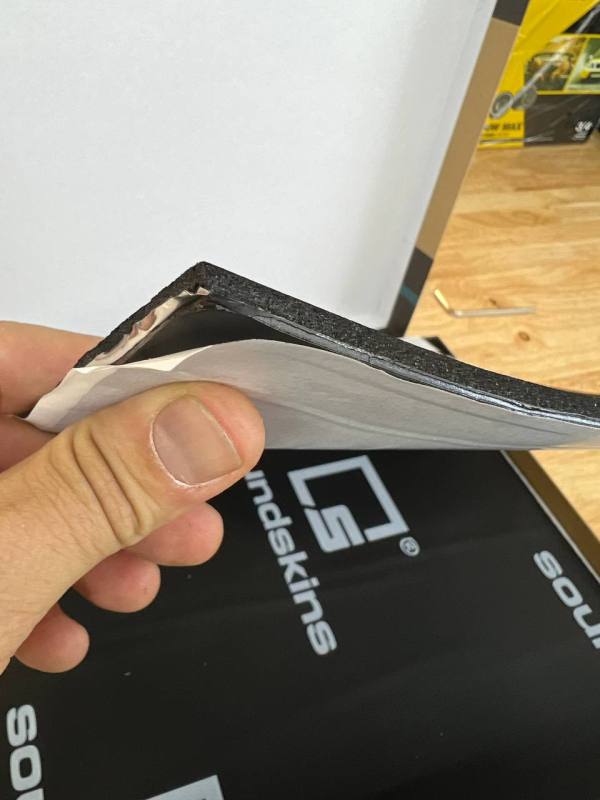
CLD material consists of an elastomeric butyl core bonded to a constraining aluminum foil sheet. Unlike obsolete asphalt-based roofing products—which off-gas toxic fumes and melt in high summer heat—butyl retains elasticity over wide temperature ranges.
When structural vibrations travel through the door skin, the butyl layer shears against the constraining aluminum backing, dissipating kinetic energy as low-level thermal energy. Applying CLD to 60% to 70% of flat, unbraced sheet metal is generally sufficient to eliminate panel ring without adding excessive weight to vehicle door hinges.
2. Closed-Cell Foam (CCF) as a Decoupler
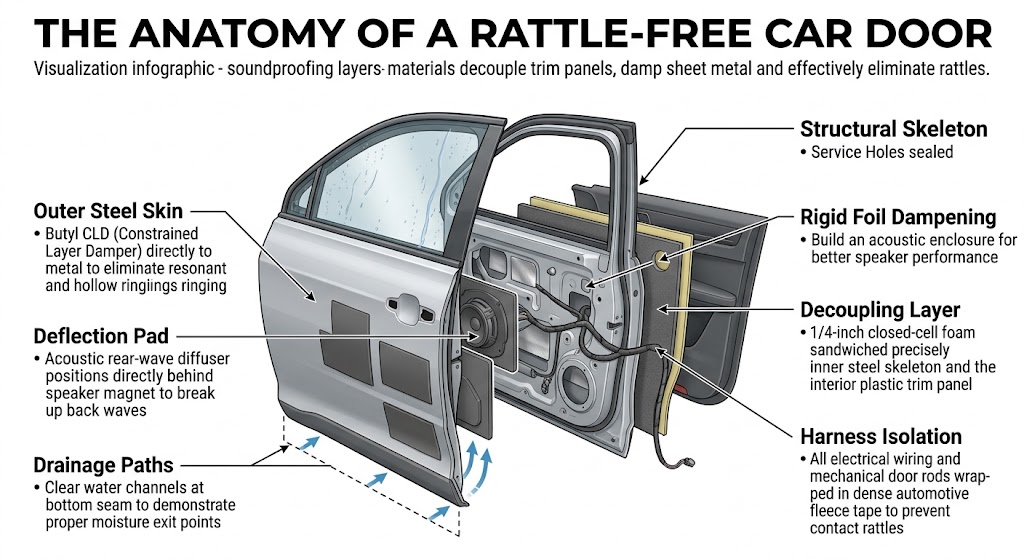
Closed-cell foam does not stop deep bass frequencies on its own due to its low mass. Its primary role is mechanical decoupling. When sandwiched between the rigid inner door metal and the flexible plastic door card, CCF acts as a physical cushion. It prevents plastic trim, wiring harnesses, and clips from vibrating against metal surfaces. Because its cell structure is closed, it will not absorb water inside door cavities.
3. Acoustic Fibers and Mass Barriers
Open-fiber acoustic absorbers (such as hydrophobic melamine foam or high-loft synthetic polyester fibers) trap airborne reflections inside the door trim. For drivers looking to isolate aggressive California tire roar on grooved concrete highways, adding a high-density barrier layer over large access openings keeps external noise from penetrating the cabin.
Step-by-Step: How to Soundproof a Door Panel for High-End Audio
Eliminating door vibration requires careful mechanical preparation. Rushing the installation leads to loose clips, blocked water drains, or windows that bind on their tracks.
Step 1: Door Panel Disassembly and Inspection
- Carefully locate and extract concealed screws hidden behind door handles, armrests, and window controls.
- Use wide nylon pry tools to release perimeter trim clips without bending the plastic card.
- Disconnect power harness plugs and mechanical door-latch release cables.
- Inspect the plastic factory vapor barrier. If retained, it can flutter under bass; removing it and sealing the access holes with rigid aluminum-backed damping material yields better acoustic separation.
Step 2: Surface Decontamination
Butyl adhesives require a chemically clean substrate to create a permanent mechanical bond.
- Clean the inner cavity and structural metal with isopropyl alcohol (IPA) or wax and grease remover.
- Avoid mineral spirits, which leave an oily residue that compromises adhesive performance.
- Ensure factory anti-rust wax along the lower seam remains intact, but clean the flat surfaces thoroughly.
Step 3: Treating the Outer Door Skin
- Cut butyl sheets into manageable rectangles to fit past safety crash beams.
- Reach inside the door cavity and adhere the material across the flat expanses of the exterior metal.
- Roll the material firmly with a polyurethane or metal roller until the aluminum foil dimples flatten out completely. Unrolled material traps air pockets, reducing vibration transfer and trapping condensation.
- Install a specialized acoustic foam pad directly behind the speaker magnet to break up back-wave reflections.
Step 4: Sealing the Inner Door Frame
- Treat the inner metal face of the door with CLD material.
- Seal the large mechanical service holes using rigid backing plates or heavy-duty foil-faced dampers. This transforms the door cavity into a semi-sealed speaker box, restoring front-to-back acoustic isolation and preventing acoustic short-circuiting.
- Keep factory drain holes along the bottom pinch-weld completely open to avoid holding rainwater.
Step 5: Decoupling Trim and Securing Linkages
- Wrap metal door lock rods and loose wire harnesses in thin closed-cell foam tubing or automotive fleece tape.
- Line the backside of the plastic door card with 1/4-inch closed-cell foam or acoustic decoupling mats.
- Replace worn factory nylon trim clips with fresh grommeted retainers to ensure a tight, rattle-free seal.
Material Comparison: Selecting the Right Deadener
| Material Type | Primary Function | Water Resistance | Best Used For |
|---|---|---|---|
| Butyl CLD (Constrained Layer Damper) | Vibration reduction / mass loading | High (Impervious) | Outer door skin, inner metal structure |
| Closed-Cell Foam (CCF) | Decoupling / anti-squeak barrier | High (Non-absorbent) | Interface between door card and steel |
| Open-Cell Acoustic Foam | Airborne high-frequency absorption | Low (Absorbs water) | Dry side of door cards only; never inside cavity |
| Automotive Fleece Tape | Harness friction damping | Moderate | Wire looms, lock linkages, cable clips |
| Asphalt-based Sheets | Low-cost damping (Outdated) | Poor (Cracks/Off-gases) | Not recommended for modern vehicle interiors |
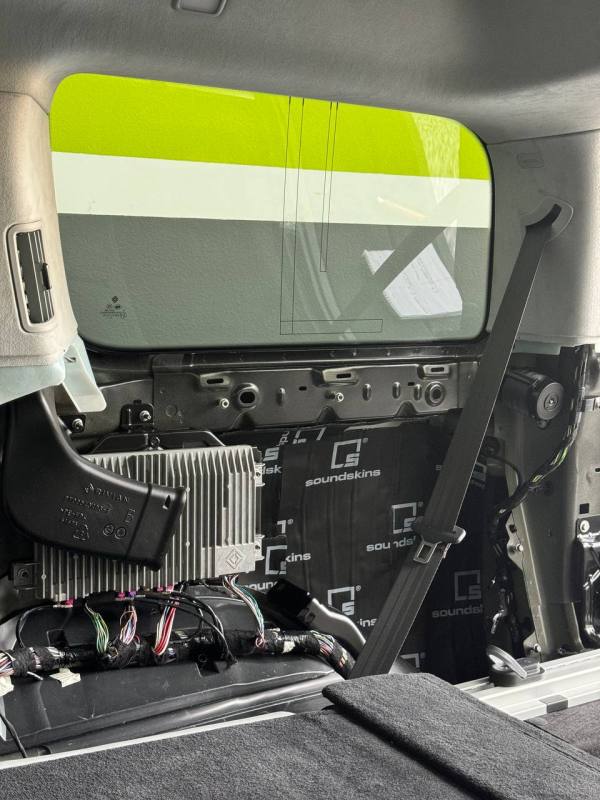
Critical Mistakes That Cause Noise and Mechanical Failure
Even high-grade sound deadening materials can fail if installed incorrectly. Professionals routinely encounter a few distinct mistakes during vehicle inspections:
- Covering Door Bottom Weep Holes: Doors are designed as “wet zones.” Rainwater runs down the exterior glass, enters the door shell, and exits through drain channels at the bottom seam. Blocking these weep holes with butyl dampening traps moisture, creating rust and damaging window motors.
- Overloading Door Hinges: Adding excessive dampening layers to a door adds unnecessary weight. Focus on panel centers where resonant flex is highest; stacking three or four layers across the entire frame stresses hinges and latches without yielding measurable acoustic gains.
- Ignoring Window Clearance: Not testing power window travel before reinstalling door cards is a common oversight. Thick dampening sheets placed along internal crash structures can catch glass tracks or pinch tint films during operation.
- Skipping Mechanical Linkages: Applying butyl directly across moving lock cables freezes mechanical components. Always ensure cables run freely in isolated sleeves or guide channels.
Original Value Asset: Door Soundproofing Diagnostic Checklist
Use this diagnostic workflow before and after installing sound deadening to verify performance and acoustic integrity.
[ ] PRE-INSTALLATION BASELINE
    [ ] Play a 50 Hz to 100 Hz test tone at moderate volume; mark rattling areas on the door card with low-tack tape.
    [ ] Perform a knuckles tap-test on outer door skin; note hollow, high-pitch ringing sections.
    [ ] Verify clean operation of manual/power locks, door handles, and power windows.

[ ] PREPARATION & APPLICATION
    [ ] Remove door panel; inspect and clean factory metal with isopropyl alcohol.
    [ ] Apply butyl CLD to inner surface of outer skin (aim for 60-70% coverage on large flat planes).
    [ ] Roll damper firmly until surface texture flattens, expelling all trapped air.
    [ ] Ensure lower condensation drain slots remain 100% unobstructed.

[ ] SEALING & MECHANICAL CLEARANCE
    [ ] Seal service access cavities to form an acoustic enclosure.
    [ ] Cycle power windows fully up and down to confirm zero clearance friction against glass.
    [ ] Wrap mechanical control rods, harnesses, and loose plugs in automotive fleece tape.

[ ] DOOR CARD RE-COUPLING
    [ ] Apply closed-cell foam decoupler to inner door skeleton or door card backing.
    [ ] Replace worn or stretched plastic trim clips with fresh, rubber-gasketed clips.
    [ ] Reinstall door card; confirm uniform gap lines along frame perimeter.
    [ ] Re-run the frequency sweep to confirm zero unwanted structural resonance.
Frequently Asked Questions
Does soundproofing car doors improve bass response?
Yes. Sealing service holes and dampening door metal transforms a hollow frame into a rigid, sealed speaker enclosure. This prevents phase cancellation, where rear sound waves meet front waves and cancel low-frequency energy. You get noticeably tighter, punchier mid-bass without replacing your factory speakers or amplifier.
How much weight does door sound deadening add to a vehicle?
A standard four-door sound deadening installation adds approximately 15 to 25 pounds across the entire vehicle. Because modern constrained layer dampers use dense butyl rather than thick asphalt, you do not need 100% coverage to kill resonance. Applying damping strategically controls vibration without sagging hinges or straining door latches.
Can sound deadening fix road noise from California freeways?
Yes, it reduces the high-frequency tire slap and low-frequency rumble caused by grooved concrete highways. Door panels act as sounding boards that amplify chassis vibration. Treating the door skin with butyl dampers and foam decouplers stops this metal flex, noticeably lowering ambient cabin decibel levels at highway speeds.
Will sound deadening materials smell or melt in extreme summer heat?
High-quality, automotive-grade sound deadening uses pure synthetic butyl rubber and aluminum constraining layers, which handle temperatures exceeding 200°F without melting or off-gassing. Problems only arise when using cheap asphalt-based alternatives, which soften, emit petrochemical odors, and lose adhesion in hot vehicles.
Should I cover the drain holes at the bottom of the door?
No. Door shells are engineered as open moisture drainage channels. Water regularly enters through exterior window weatherstripping and drains out through small weep holes in the bottom seam. Covering these ports traps standing water inside the frame, causing rust, electrical failures, and mold.
Professional Sound Isolation for California Drivers
Rattles and door panel vibrations degrade the clarity of an otherwise high-performing sound system. While adding mass and decoupling trim seems straightforward, achieving consistent results requires balancing proper material placement with vehicle safety systems, wiring harnesses, window regulators, and drainage paths.
If you are ready to eliminate cabin resonance and bring studio-grade audio to your daily drive, professional installation ensures your vehicle gets treated with surgical precision. Explore the dedicated Soundproofing service by Sorena Car Audio to transform your vehicle’s interior acoustic environment in Irvine and across Orange County.
Author Information & Trust Section
This guide was prepared using trusted industry standards and verified automotive audio acoustic engineering practices to ensure clarity, vehicle longevity, and optimal acoustic performance.
We offer all car audio services
List of Services:
- DashCam
- Ambient Lighting
- Starlight
- Windows Tinting
- Armoring & Ballistic Protection
- Apple CarPlay
- Dash Upgrade
- Android Auto
- Paint Protection Film (PPF)
- Sound Deadening – Sound Proofing
- Front and Rear Parking Sensors
- Blind Spot Radars
- Car Ceramic Coating
- HD Backup Camera
- Mirror Monitor
- Subwoofer Integration
- Classic Car Audio
- Wheel Well Sound Deadening
- Marine Audio System
- Marin Audio
- Flipdown Monitor
- Bluetooth Integration
- Rear Entertainment System
- Steerig Wheel Upgrade
- Car Wrapping
- Interior Suede Alcantara Wrap
- Alcantara Suede Headliner
- ECU Tuning
- Center Console Safe Installation
Leave A Comment