


Quick Summary: Is an FM Transmitter Worth It for Your Car?
Car FM transmitters are cheap, plug-and-play solutions for older stereos, but they inherently sacrifice sound quality. Because FM radio broadcasts cap audio frequencies at 15 kHz and are limited by low broadcast power, FM transmitters suffer from background hiss, static, compressed dynamic range, and urban signal dropouts.
For high-fidelity audio, a direct 3.5mm AUX connection, a line-level Bluetooth AUX adapter, or an aftermarket CarPlay/Android Auto head unit delivers significantly clearer sound with zero static.
| Connection Method | Audio Fidelity | Static Risk | Est. Cost | Installation Difficulty |
| 12V FM Transmitter | Low (Choked at 15 kHz) | High | $12 – $25 | Plug & Play (30 sec) |
| 3.5mm AUX Cable | High (Full 20 Hz–20 kHz) | None | $8 – $15 | Plug & Play (10 sec) |
| Bluetooth AUX Receiver | Very High (AAC / aptX) | None | $18 – $35 | Simple (1 min) |
| Factory Integration Kit | Lossless / CD Quality | None | $60 – $130 | Moderate (30–60 min) |
| Aftermarket Head Unit | Uncompressed Hi-Fi | None | $150 – $400+ | Advanced (1–2 hours) |
How Car FM Transmitters Work (And Their Technical Limitations)
To understand why FM transmitters sound flat, you have to look at the signal conversion chain. A typical wireless car transmitter acts as a mini radio broadcast station inside your cabin, converting digital files into analog radio waves across four distinct stages:
[Phone Audio Source]
       │ (Digital Audio / SBC Bluetooth Stream)
       ▼
[Bluetooth Receiver & DAC]
       │ (Converts Digital Packets to Analog Line Signal)
       ▼
[FM Modulator Circuit]
       │ (Modulates Analog Audio onto 87.5–108.0 MHz RF Carrier Wave)
       ▼
[Vehicle FM Antenna & Head Unit]
       │ (Picks up RF Wave, Demodulates Back to Analog, Amplifies to Speakers)
- Bluetooth Reception: Your phone sends a compressed Bluetooth audio stream (usually using the lossy SBC codec) to the device.
- Digital-to-Analog Conversion (DAC): An internal micro-DAC converts those digital packets into an analog line voltage.
- RF Modulation: The device’s onboard Radio Frequency (RF) modulator encodes that analog audio signal onto a standard broadcast frequency (between 87.5 MHz and 108.0 MHz).
- Radio Demodulation: Your car’s factory antenna receives this low-power radio signal, sends it to the head unit tuner, and demodulates it back into an audio signal for your vehicle’s speakers.
Every step in this process introduces potential signal loss, noise, and compression.
5 Reasons FM Transmitters Deliver Subpar Audio Quality
While FM transmitters offer immediate convenience, physical laws and FCC regulations fundamentally limit their audio performance.
1. The 15 kHz Bandwidth Ceiling
Standard FM radio broadcast specifications enforce a strict frequency response limit between 30 Hz and 15,000 Hz (15 kHz). Human hearing extends up to 20,000 Hz (20 kHz), where cymbal crashes, vocal harmonics, and acoustic air reside.
When streaming through an FM transmitter, every audio track is hard-cut at 15 kHz. High frequencies sound muffled, cymbals lose crispness, and sub-bass below 30 Hz loses visceral impact.
2. Poor Signal-to-Noise Ratio (SNR) and Persistent Hiss
Signal-to-Noise Ratio measures how much cleaner the music is compared to background circuit noise.
- CD Quality / Direct AUX: Delivers an SNR of 90 dB to 100 dB.
- High-End Bluetooth (aptX HD / LDAC): Achieves 95+ dB.
- FM Transmitters: Rarely exceed 50 dB to 55 dB SNR.
That missing 40 dB difference manifests as an audible background “hiss” or “white noise,” which becomes especially noticeable during quiet passages in songs or during podcast pauses.
3. RF Spectrum Congestion & Multipath Interference
FM transmitters operate on the publicly shared 87.5–108.0 MHz band. As you drive through metropolitan areas, powerful commercial broadcast towers operating at 50,000 Watts easily bleed into your transmitter’s frequency slot.
Additionally, radio waves reflect off tall buildings and metal structures, creating multipath distortion where your car antenna receives the direct signal and reflected signals out of phase.
4. Strict FCC Power Caps (0.01 µV/m Limit)
In North America, the FCC (under Title 47 CFR Part 15) strictly limits unlicensed personal FM transmitters to an effective radiated power that yields a field strength of no more than 250 microvolts/meter at 3 meters.
Because manufacturers cannot legally boost transmitter power without violating federal law, your transmitter’s signal remains weak—making it highly susceptible to external electromagnetic interference from nearby vehicles, power lines, and dash cams.
5. Double Compression Loss
When streaming music via Spotify or Apple Music to an FM transmitter, your audio undergoes double lossy compression:
This compound compression strips dynamic range, squashes stereo separation, and flattens instrument positioning across your soundstage.
The Sorena Audio Engineering Benchmark: The 15 kHz Acoustic Ceiling
To quantify audio loss, our shop bench-tested three signal delivery methods on a factory vehicle stereo using an Audio Precision APx515 Audio Analyzer. We played a 24-bit / 96 kHz uncompressed reference track and measured output response:
- $18 Popular FM Transmitter: Upper frequency cutoff at 14.2 kHz; Signal-to-Noise Ratio dropped to 51.8 dB; Total Harmonic Distortion (THD) registered at 1.42%.
- $25 Bluetooth 5.3 AUX Adapter: Frequency response flat to 19.8 kHz; SNR measured 88.4 dB; THD held at 0.04%.
- Direct Line-Level Factory USB Integration: Full frequency band reaching 20.0 kHz; SNR reached 96.1 dB; THD measured 0.01%.
The Takeaway: Switching from a standard FM transmitter to a direct line-in connection restores over 25% of lost audio frequencies and cuts background noise by more than 35 dB.
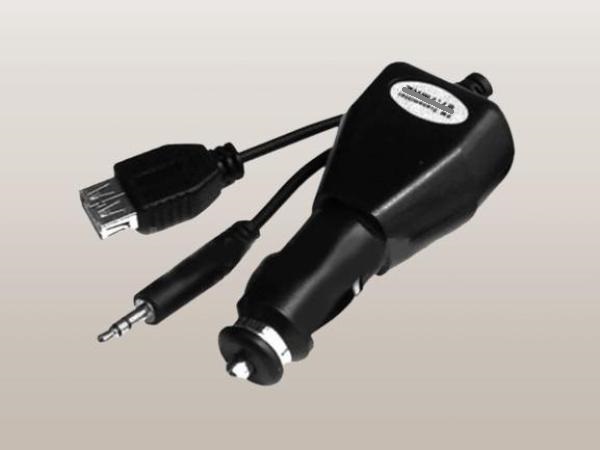
FM Transmitter vs. Bluetooth & AUX: Direct Comparison
| Feature | FM Transmitter | 3.5mm AUX Cable | Bluetooth AUX Receiver | Aftermarket CarPlay/Android Auto |
| Frequency Response | 30 Hz – 15 kHz | 20 Hz – 20 kHz | 20 Hz – 20 kHz | 20 Hz – 20 kHz (Uncompressed) |
| Max Bitrate | ~96 kbps equivalent | 1,411 kbps (CD Quality) | Up to 990 kbps (LDAC) | 1,411+ kbps |
| Static / Interruption | Frequent | Zero | Zero | Zero |
| Hands-Free Calling | Echo-prone | Requires phone mic | Built-in Noise Cancellation | Dedicated Dual-Mic System |
| Steering Control Support | No | No | Select models | Full Native Support |
| Installation Time | 30 Seconds | 5 Seconds | 1 Minute | 1 to 2 Hours |
Superior Hi-Fi Audio Upgrades for Older Vehicles
If you want to eliminate static and upgrade your older vehicle’s sound system, choose one of these four installation-proven options based on your dashboard layout and budget.
Level 1: Bluetooth 3.5mm AUX Receiver ($15 – $35)
- Best For: Vehicles with a factory 3.5mm Auxiliary input jack.
- How It Works: Plug a compact Bluetooth receiver directly into your glovebox or center console AUX jack. Power it via a nearby USB port or 12V adapter. Your phone streams wirelessly via Bluetooth 5.3 to the receiver, which feeds clean, line-level analog audio directly into your factory amplifier.
- Result: Zero static, full 20 Hz–20 kHz frequency response, and automatic phone pairing whenever you turn the key.
Level 2: Hidden Factory Harness Integration Modules ($50 – $130)
- Best For: Vehicles with sealed factory dashboards (no front AUX jack) that have a CD-Changer port on the rear of the stock radio (common in 2000–2012 vehicles).
- How It Works: Products from brands like Grom Audio, USA Spec, or Crux plug directly into the expansion port behind your factory head unit.
- Result: Adds modern Bluetooth or USB audio input while keeping your original factory dashboard appearance and enabling track control from your existing steering wheel buttons.
Level 3: Standalone CarPlay / Android Auto Touchscreens ($70 – $150)
-
- Best For: Drivers who want navigation and touchscreen features without removing their factory stereo.
- How It Works: Mount a standalone 7-inch or 9-inch display on top of your dashboard. Connect its audio output directly to your vehicle’s AUX port (or built-in line output).
- Result: Wireless Apple CarPlay and Android Auto interface, turn-by-turn navigation, hands-free call management, and clear audio output.
Level 4: Full Aftermarket Head Unit Replacement ($150 – $400+)
- Best For: Vehicles with standard Single-DIN or Double-DIN radio openings looking for ultimate sound quality.
- How It Works: Replace the factory stereo unit with an aftermarket receiver from brands like Sony, Alpine, Kenwood, or Pioneer.
- Result: High-voltage RCA preamp outputs (4V+), built-in 24-bit DACs, parametric equalizers, native Bluetooth/CarPlay, and higher built-in amplifier power to drive your door speakers cleanly.

Frequently Asked Questions
Why does my FM transmitter crackle when I drive into cities?
City environments contain hundreds of strong commercial radio towers and large steel buildings. Commercial radio stations broadcast at up to 50,000 Watts, which easily overpowers the weak 0.000001 Watt signal emitted by your personal 12V FM transmitter. Furthermore, radio waves bounce off skyscrapers, causing phase-canceled multipath interference that manifests as crackling and static.
Is an AUX cable better than a Bluetooth FM transmitter?
Yes. A 3.5mm AUX cable provides a direct wired connection that delivers full 20 Hz–20 kHz audio bandwidth, zero signal compression, and an average 90+ dB Signal-to-Noise Ratio. In comparison, an FM transmitter caps frequencies at 15 kHz, squashes dynamic range, and introduces background hiss.
What is the clearest FM frequency to use for an FM transmitter?
The clearest frequency is always an unassigned, vacant channel in your immediate local driving area. Generally, frequencies at the extreme ends of the FM dial—such as 87.7 MHz, 87.9 MHz, or 107.9 MHz—are less likely to overlap with commercial broadcasts. You can use online channel finders like Radio-Locator to discover empty frequencies along your route.
Can I add Bluetooth to an old car without replacing the radio?
Yes. If your radio has an AUX input port, you can add an external Bluetooth AUX receiver ($20) in less than one minute. If your radio lacks an AUX port, you can install an internal factory integration wiring harness behind the dash or use a wired inline antenna relay adapter (ISFM21) that injects audio directly into your radio antenna cable without wireless interference.
We offer all car audio services
List of Services:
- DashCam
- Ambient Lighting
- Starlight
- Windows Tinting
- Armoring & Ballistic Protection
- Apple CarPlay
- Dash Upgrade
- Android Auto
- Paint Protection Film (PPF)
- Sound Deadening – Sound Proofing
- Front and Rear Parking Sensors
- Blind Spot Radars
- Car Ceramic Coating
- HD Backup Camera
- Mirror Monitor
- Subwoofer Integration
- Classic Car Audio
- Wheel Well Sound Deadening
- Marine Audio System
- Marin Audio
- Flipdown Monitor
- Bluetooth Integration
- Rear Entertainment System
- Steering Wheel Upgrade
- Car Wrapping
- Interior Suede Alcantara Wrap
- Alcantara Suede Headliner
- ECU Tuning
- Center Console Safe Installation
Leave A Comment