

Modern vehicle technology moves rapidly, yet millions of drivers on the road today still operate cars lacking essential driver-assistance systems. While new luxury vehicles roll off factory floors loaded with multi-camera arrays and millimeter-wave radar sensors, older models—and even base-tier new vehicles—often leave drivers relying solely on traditional mirrors and basic spatial awareness.
Fortunately, the aftermarket car electronics industry in 2026 offers safety upgrades that match or exceed OEM (Original Equipment Manufacturer) factory performance. Whether navigating congested California freeways, parallel parking in tight urban lots, or capturing legal evidence in the event of a hit-and-run, retrofitting your vehicle with modern safety tech is one of the most effective ways to protect your asset and your passengers.
This guide compares the three foundational aftermarket safety categories—4K Dashcams, Microwave Blind Spot Radar Systems, and High-Definition Backup Cameras—explaining how each technology works, how to satisfy local legal requirements, and how to select the right combination for your driving environment.
Key Takeaways
| Safety System | Primary Function | Ideal Application | Key 2026 Tech Milestone |
|---|---|---|---|
| Multi-Channel Dashcams | Visual evidence recording & park mode monitoring | Accident liability defense & vandalism protection | Sony STARVIS 2 sensors with HDR & direct cloud LTE connectivity |
| Microwave Blind Spot Radar | Active driver notification of obscured lane threats | Highway changing maneuvers & heavy traffic navigation | 77GHz millimeter-wave radar behind bumper (no drilling required) |
| HD Backup Cameras | Direct rear-quadrant obstacle visibility | Reversing, parking, and trailer hitching | AHD 1080p resolution integrated into factory dashboard screens |
Aftermarket Dashcams: Continuous Evidence and Parking Security
A dashcam acts as an objective, silent witness to every second you spend on the road. Modern aftermarket dashcams have evolved far beyond basic windshield-mounted cameras, now offering dual- and triple-channel setups that monitor forward, interior, and rear perspectives simultaneously.
Sony STARVIS 2 and Low-Light Superiority
The biggest technological leap in 2026 dashcams is the widespread integration of Sony STARVIS 2 image sensors. Older dashcams struggled significantly at night, frequently blowing out license plate reflections from headlights or rendering dark streets as grainy shadows. STARVIS 2 sensors feature dynamic range exceeding 88 dB in a single exposure, allowing cameras to capture crisp license plate numbers and street signage even in dark or high-contrast night driving.
Parking Mode Protection
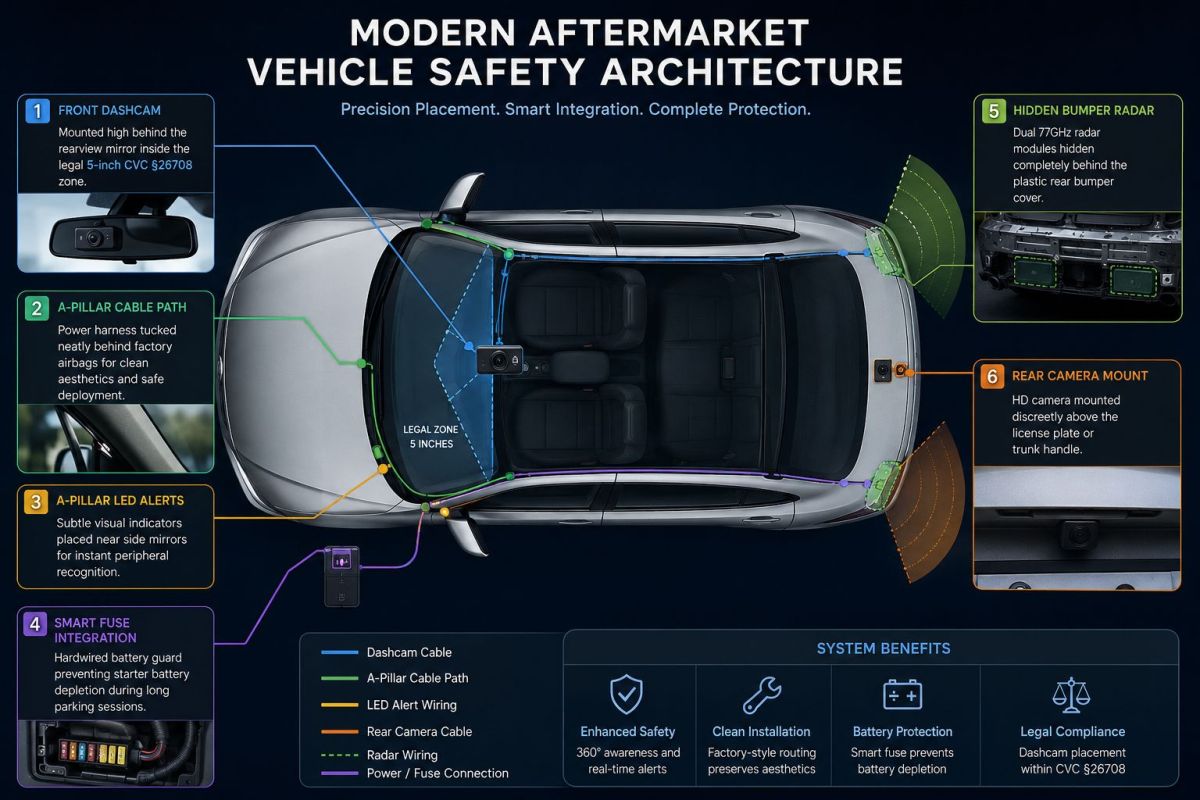
Advanced dashcams are hardwired directly into your vehicle’s fuse panel using smart battery-drain prevention modules. When your ignition turns off, the camera enters low-power Parking Mode, monitoring motion or impact using internal G-sensors. If a hit-and-run occurs while your car is parked, the camera wakes instantly to capture high-definition footage before and after the collision.

California Legal Mounting & Privacy Compliance
If you drive in California, installing a dashcam requires strict compliance with state regulations:
- Windshield Placement Rules (California Vehicle Code § 26708): To maintain an unobstructed field of view, California law permits windshield dashcam mounting in only three specific zones:
- A 7-inch square in the lower corner of the windshield farthest from the driver (passenger side).
- A 5-inch square in the lower corner nearest the driver.
- A 5-inch square in the upper center portion of the windshield directly behind or adjacent to the rearview mirror.
- Airbag Deployment Zones: Mounting hardware and wiring must never cross or interfere with A-pillar or curtain airbag deployment paths.
- Audio Recording Laws: California is a two-party consent state. If your dashcam records cabin audio, you are legally required to inform passengers or disable interior audio recording.
To learn how professional hardwiring keeps interior cables entirely hidden and retains factory vehicle aesthetics, read our guide to professional car audio and electronics installation.
Aftermarket Blind Spot Radar: Eliminating the Side-View Blind Spot
While convex blind-spot mirrors offer a passive visual aid, true blind spot monitoring actively alerts drivers to approaching vehicles moving at higher speeds.
                 [ Vehicle Ahead ]
                         |
[ Blind Spot ] <-- [ Your Car ] --> [ Blind Spot ]
 (Radar Zone)         (Driver)       (Radar Zone)
Microwave Radar vs. Ultrasonic & Camera Systems
When evaluating aftermarket blind spot detection systems, understanding the underlying technology is critical:
- 77GHz Microwave Radar Systems (Recommended): Installed concealed inside the rear bumper fascia, radar sensors penetrate plastic panels without requiring external holes. Radar accurately calculates both distance and relative approach speed, operating reliably through rain, fog, darkness, and direct sunlight.
- Ultrasonic Sensor Kits (Outdated): Older aftermarket kits used parking sensors drilled into the bumper. These have short ranges, frequently emit false triggers from guardrails or rain, and fail to detect vehicles approaching rapidly from behind.
- Mirror Camera Systems: Camera-based systems feed live side views to a screen when signaling. While useful, they require the driver to look away from the road toward a monitor, whereas radar provides instant visual LED indicators on the A-pillars or side mirrors alongside audible chimes.
Aftermarket Backup Cameras: Rear Obstacle and Cross-Traffic Clearance
Since May 2018, backup cameras have been mandatory equipment on new light vehicles built in the United States. However, millions of older cars lack this essential safety feature. Aftermarket integration brings high-definition backup camera capabilities to virtually any vehicle.
[ HD Camera (Rear Bumper/Plate) ] ---> [ Interface Module ] ---> [ OEM / Aftermarket Screen ]
OEM Integration vs. Standalone Monitors
Modern aftermarket backup cameras offer three distinct display options:
- Factory Screen Integration: Using vehicle-specific interface modules, professional technicians can display live rear camera feeds directly onto your factory dashboard screen when shifted into reverse.
- Aftermarket Head Unit Replacement: Upgrading an older stereo to an Apple CarPlay / Android Auto touchscreen provides a native 7- to 10-inch HD camera display while simultaneously modernizing your infotainment system.
- Rearview Mirror Displays: For vehicles where replacing the factory stereo is undesirable, replacement rearview mirrors with embedded IPS displays remain completely invisible until reverse gear is engaged.
Comparison: Choosing the Right Safety Upgrade Matrix
| Feature / Criteria | 4K Dashcam System | 77GHz Blind Spot Radar | HD Backup Camera |
|---|---|---|---|
| Primary Safety Focus | Evidence gathering & parking guard | Active lane-change safety | Reversing & parking clearance |
| Alert Type | None (Passive recording) | Visual LED + Audible Chime | Live Video Feed + Distance Grid |
| Weather Dependency | Needs clean windshield/lens | All-weather (Radar pierces rain/fog) | Lens needs occasional wiping |
| Installation Complexity | Moderate (A-pillar cabling, fuse tap) | Advanced (Rear bumper removal, wiring) | Moderate to Advanced (Dashboard integration) |
| Primary Risk Mitigated | Insurance fraud & hit-and-run loss | Sideswipe & lane-merge collisions | Backover accidents & property damage |
For drivers exploring complete vehicle upgrades, view our overview of Apple CarPlay and multimedia dash installations.
2026 Aftermarket Driver Safety Tech Decision Matrix
Follow this structured evaluation framework to identify the right safety equipment for your driving profile:
- Primary Concern: Urban Parking & Vandalism
- Recommended Setup: 2-Channel (Front + Rear) 4K Dashcam with Sony STARVIS 2 sensor, paired with a low-voltage battery protection hardwire kit or dedicated dashcam battery pack.
- Primary Concern: Highway Commuting & Frequent Lane Changes
- Recommended Setup: 77GHz Microwave Blind Spot Radar kit with interior A-pillar LED indicators and speed-sensing GPS triggers to eliminate low-speed false alarms.
- Primary Concern: Tight Parking, Towing, or Older Vehicle Retrofitting
- Recommended Setup: AHD 1080p Backup Camera with dynamic parking trajectory lines integrated into a floating touchscreen Apple CarPlay receiver.
- Ultimate Safety Package
- Recommended Setup: A fully integrated triple-threat system incorporating a front/rear 4K dashcam, bumper-concealed radar, and factory-screen backup camera integration.
Frequently Asked Questions
Are aftermarket blind spot monitoring systems as accurate as factory-installed systems?
Yes, provided you choose a system utilizing 77GHz microwave radar technology rather than cheap ultrasonic sensors. Professional-grade 77GHz radar sensors measure velocity and distance with high precision, operating through rear bumper panels exactly like OEM factory systems. Proper positioning during installation is critical to calibrate sweep angles and eliminate false alerts.
Will installing an aftermarket safety device void my vehicle’s manufacturer warranty?
No. Under the federal Magnuson-Moss Warranty Act, vehicle manufacturers cannot void your warranty simply because you installed aftermarket equipment. A dealership must prove that the specific aftermarket installation directly caused a mechanical or electrical failure to deny a warranty claim. Professional installation ensures factory wire harnesses remain undamaged and warranty protections remain intact.
Can I install a backup camera if my car has an older factory radio without a screen?
Yes. Technicians can replace your older factory radio with a modern touchscreen head unit featuring Apple CarPlay and Android Auto. Alternatively, if you wish to keep your original dash layout intact, you can install a replacement rearview mirror equipped with a hidden high-definition monitor that illuminates only when in reverse.
How does a dashcam stay powered when my car is parked without draining the battery?
Professional dashcam installations utilize a dedicated hardwire kit connected to your vehicle’s fuse box. These modules feature programmable low-voltage cutoffs (e.g., shutting power off if vehicle battery drops below 12.0V). For extended multi-day parking coverage, dedicated lithium-iron-phosphate (LiFePO4) auxiliary dashcam batteries can be installed to power the camera system independently.
Conclusion
Upgrading your vehicle with aftermarket safety devices is one of the smartest investments you can make in driver confidence, collision prevention, and liability protection. Whether you choose a high-resolution 4K dashcam for round-the-clock surveillance, microwave blind spot radar for relaxed highway driving, or a crisp backup camera for easy parking, modern aftermarket solutions deliver true factory-level performance.
To ensure seamless integration, zero visible wiring, and full compliance with vehicle electrical standards, expert installation is key.
If you are located in Southern California, visit Sorena Car Audio in Irvine, CA. As Orange County’s premier car electronics and custom audio specialists, Sorena Car Audio provides expert advice, premium aftermarket safety equipment, and meticulous OEM-quality installation tailored specifically to your vehicle.
Reviewed by the Senior Technical Team at Sorena Car Audio. This guide reflects current professional installation standards, automotive electronic best practices, and regional compliance guidelines for 2026.
We offer all car audio services
List of Services:
- DashCam
- Ambient Lighting
- Starlight
- Windows Tinting
- Armoring & Ballistic Protection
- Apple CarPlay
- Dash Upgrade
- Android Auto
- Paint Protection Film (PPF)
- Sound Deadening – Sound Proofing
- Front and Rear Parking Sensors
- Blind Spot Radars
- Car Ceramic Coating
- HD Backup Camera
- Mirror Monitor
- Subwoofer Integration
- Classic Car Audio
- Wheel Well Sound Deadening
- Marine Audio System
- Marin Audio
- Flipdown Monitor
- Bluetooth Integration
- Rear Entertainment System
- Steerig Wheel Upgrade
- Car Wrapping
- Interior Suede Alcantara Wrap
- Alcantara Suede Headliner
- ECU Tuning
- Center Console Safe Installation
Leave A Comment